Most people hiring an auto detailing shop in the Chicago suburbs make the same mistake: they search for the lowest price and call it research. A week later, they are staring at new swirl marks or a ceramic coating that is already beading poorly because it was applied over contaminated paint. If you drive a luxury vehicle and you live in Carol Stream, Bloomingdale, Wheaton, or anywhere in the northwest suburbs, you cannot afford that mistake. Knowing how to choose auto detailing in Chicago suburbs means asking the right ten questions before a single drop of water touches your paint.
Table of Contents
- Quick Takeaways
- Why These Questions Matter for Chicago-Area Drivers
- Comparing Detailing Tiers: What You Actually Get
- Frequently Asked Questions
- References
Quick Takeaways
| Key Insight | Explanation |
|---|---|
| Decontamination is non-negotiable before any coating | A professional must describe both chemical decontamination (iron fallout remover) and physical decontamination (clay bar) before polishing or coating. One step alone is insufficient. |
| 50/50 photos are the only honest proof of paint correction skill | Before-and-after photos taken under harsh direct lighting on the same panel show real results. Marketing photos taken in flattering light can hide poor work. |
| Certifications signal product knowledge, not just hustle | Manufacturer certifications (such as Koch Chemie) require trained application technique, not just brand loyalty. Ask which certifications the detailer holds and from whom. |
| A warranty is only as good as what it excludes | Ask exactly what voids the coating warranty. Some shops exclude bird dropping damage, road salt, or automated car washes, which are all real-world hazards in Illinois. |
| Liability insurance protects your vehicle's value | Without current liability insurance, any damage to your car during the detail becomes a personal dispute with no recourse. Always request proof of coverage. |
| Itemized pricing reveals corners being cut | A vague "full detail" quote often means steps are bundled and hidden. Itemized quotes separate prep, correction, and coating so you know exactly what you are paying for. |
| Aftercare support separates professional shops from one-time vendors | A quality shop provides written aftercare instructions and offers follow-up appointments. A shop that goes silent after payment is a red flag. |
Why These Questions Matter for Chicago-Area Drivers
The Chicago suburbs present specific environmental threats that most detailing guides written for warm-climate markets never address honestly. Road salt is spread heavily from November through March across DuPage County roads, and it is one of the fastest ways to accelerate clear coat breakdown. Add to that the UV intensity of a genuine Midwest summer, and your paint is under attack for most of the year.
Choosing the wrong detailing shop does not just mean a less-than-perfect shine. It can mean swirl marks introduced by an inexperienced machine operator, a ceramic coating applied over chemically contaminated paint that will delaminate within months, or a paint correction job that removes too much clear coat because the technician did not measure paint depth. These are not hypothetical risks. They are the most common outcomes when suburb residents pick a shop based on a Google Maps listing alone.
The ten questions below are not a checklist for being difficult. They are the exact questions a knowledgeable friend in the industry would tell you to ask before handing over your keys.
What Certifications or Training Do You Hold?
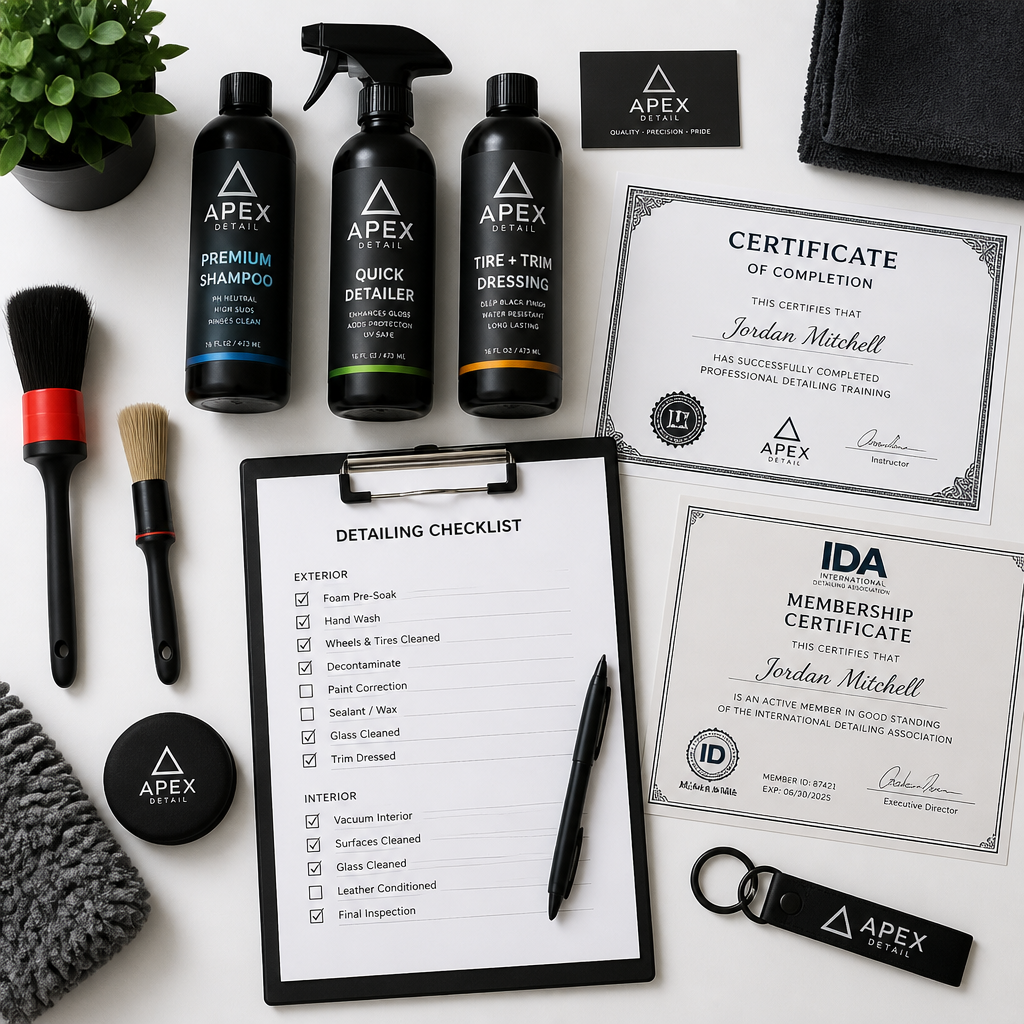
This question immediately separates shops that have invested in their craft from those that bought a polisher and started charging. Manufacturer certifications, such as those issued by professional-grade chemical brands, require the detailer to demonstrate proper application technique, surface preparation knowledge, and product chemistry understanding. They are not handed out with a purchase.
For example, Hersheys Detailing in Glendale Heights is certified by Koch Chemie, a professional detailing chemistry brand. That certification is not a marketing badge. It means the technicians have been trained on specific dilution ratios, application sequences, and surface compatibility, details that directly affect whether your paint comes out better or worse than it went in.
Pro tip: Ask to see the actual certificate, not just a logo on the website. A shop that is genuinely certified will have documentation. A shop that is not will change the subject.
Why self-taught is not automatically bad, but experience depth matters
Some excellent detailers are self-taught, but they compensate for the lack of formal certification with a verifiable track record: a detailed portfolio, documented client history, and real before-and-after results. If a shop has no certifications and no portfolio, that is when you should look elsewhere. The two can offset each other; neither alone is a dealbreaker if the evidence supports the skill.
Walk Me Through Your Decontamination Process
This is the most technically revealing question on this list. A professional detailer will immediately describe a two-stage approach: chemical decontamination using an iron fallout remover to dissolve ferrous particles embedded in the paint, followed by physical decontamination with a clay bar to lift remaining bonded contaminants. If a shop describes the decontamination process as simply "a thorough wash," that is not decontamination. That is marketing language for skipping a step.
Why does this matter so much? Because ceramic coatings bond to paint at the molecular level. If the surface beneath is contaminated with iron fallout from brake dust, road grit, or industrial particles (all common in suburban Chicago driving), the coating bonds to the contamination, not to the paint. The result is uneven protection that fails prematurely.
The Illinois-specific contamination problem
Road salt and industrial fallout from the Chicago metro area mean that vehicles driven on suburban Illinois roads accumulate surface contamination at a rate that exceeds most other parts of the country. A car parked outside in Glendale Heights or Carol Stream for a single winter season may have iron particles visibly embedded in the clear coat. Decontamination is not a luxury step for track cars. It is basic preparation for any quality detail in this climate.
What Paint Correction Method Do You Use?
Paint correction is not a single process. There is a meaningful difference between a one-stage enhancement polish, a two-stage correction, and a multi-stage correction. The right answer depends on the condition of your paint, and a competent detailer will assess your paint with a paint depth gauge before recommending anything.
Ask specifically whether the shop uses a dual-action (DA) polisher or a rotary machine. A DA polisher is more forgiving and appropriate for most correction work. A rotary produces more heat and is effective in the hands of an experienced operator but can burn through clear coat quickly if misused. The honest answer from a professional includes an explanation of when and why they choose each tool, not a blanket claim that "we use the best equipment."
Pro tip: Ask if the shop measures paint depth before starting correction work. A shop that does not check paint thickness before polishing has no idea how much working room they have. On a luxury vehicle with factory paint, this is the difference between a restored finish and a car that needs a respray.
Which Ceramic Coating Product Do You Install and Why?
Consumer-grade ceramic coatings sold online and professional-grade coatings installed by trained detailers are not the same category of product. The chemistry, concentration of SiO2 (silicon dioxide), and curing requirements differ significantly. A professional shop should be able to name the specific product they use, explain why they chose it over alternatives, and describe what it offers in terms of hardness rating, hydrophobic performance, and warranty duration.
Be cautious of shops that refuse to name their coating product. Legitimate professional-grade coatings carry the installer's reputation, and a shop that installs them is proud to say so. Vagueness usually means a consumer-grade product is being installed at professional-grade prices.
What a 5 to 8 year coating warranty actually requires
Ceramic coatings with genuinely long warranties, in the range of five to eight years, require meticulous surface preparation, including full paint correction in most cases, proper curing time in a controlled environment, and often annual inspection appointments. A shop offering an eight-year warranty with a same-day turnaround and no mention of preparation or curing is making promises the product cannot keep.
Can I See Your Portfolio, Specifically 50/50 Photos?
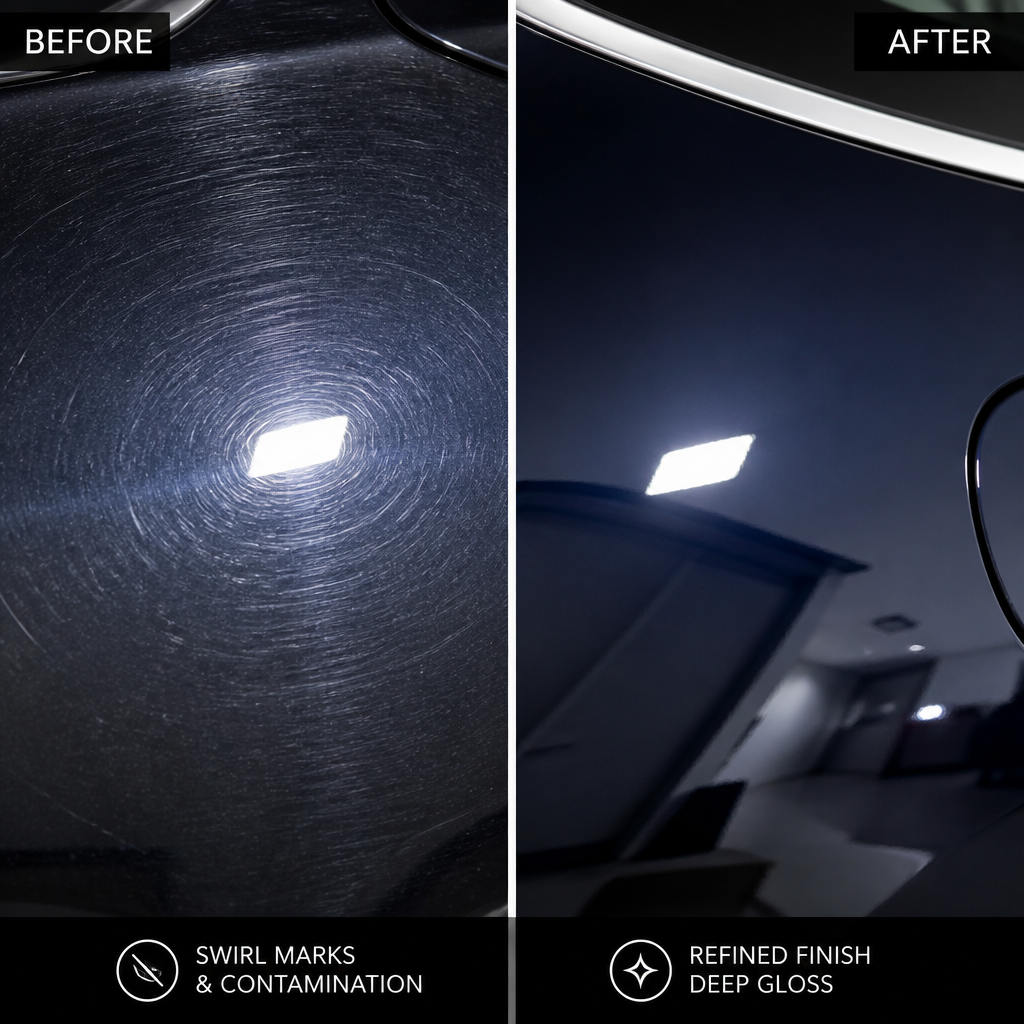
Every detailing shop has photos of shiny cars. That proves nothing. What you want to see are 50/50 photos: images taken during the correction process where exactly half the panel has been polished and the other half has not, shot under direct, harsh lighting. This is the standard way professionals document genuine paint correction results, and it is nearly impossible to fake.
Ask to see 50/50 photos on vehicles similar to yours in color and paint type. Dark-colored paint (black, dark blue, dark grey) shows defects far more severely than white or silver, so a portfolio that only shows light-colored vehicles is not comprehensive evidence of skill on your car.
What Does Your Warranty Actually Cover?
A warranty is a written promise, not a verbal reassurance. Before you commit to a ceramic coating service, ask for the warranty terms in writing and read every exclusion. Common exclusions in coating warranties include damage from automated car washes, failure to follow prescribed maintenance schedules, bird droppings or tree sap left on the surface for extended periods, and physical damage from road debris.
For Illinois drivers specifically, ask whether the warranty covers road salt exposure and whether the shop offers annual inspection appointments to document the coating's condition. A shop that warranties their work but never wants to see the car again after installation has little incentive to ensure the coating was applied correctly.
The difference between manufacturer warranty and shop warranty
Some shops pass through the coating manufacturer's warranty. Others offer their own warranty backed by their workmanship. The best arrangements combine both: the manufacturer guarantees the product chemistry and the shop guarantees the preparation and application. If you are only getting one of the two, ask which and why.
Do You Carry Liability Insurance?
This question is rarely asked and almost never answered voluntarily. Liability insurance matters because it protects your vehicle during the detailing process. If a technician drops a rotary polisher on your hood, scratches your glass with an improperly cleaned tool, or damages interior surfaces during an extraction cleaning, you need recourse beyond an argument.
Request proof of a current liability insurance policy, not just a verbal confirmation. A legitimate business carries this coverage as a matter of course, and asking for proof is not an insult. Any shop that becomes defensive about this question is telling you something about how they operate.
Can You Give Me an Itemized Breakdown of Pricing?
Vague package pricing is where corners get hidden. A quote that says "full detail plus coating, $1,200" tells you almost nothing about what you are actually receiving. An itemized quote separates the wash and decontamination, the paint correction stage or stages, the coating application, and any additional services such as glass coating, wheel coating, or interior work. Each line item should be defensible with a time estimate or product cost.
Comparing quotes between shops becomes meaningful only when the scope of work is itemized. A $900 quote that includes two-stage paint correction and a professional-grade SiO2 coating is a completely different value proposition than a $900 quote that includes a single-stage polish and a consumer-grade spray coating. You cannot know which one you are looking at unless the pricing is broken down.
Transparency in pricing directly reflects a detailer's commitment to quality work. A shop that cannot explain what every line item covers is a shop that has something to hide in the process.
How Long Will the Job Take and Where Is It Done?
Realistic timelines are a quality signal. A proper two-stage paint correction followed by ceramic coating application and an adequate curing period is a multi-day process for most vehicles. Any shop promising a same-day ceramic coating on a vehicle that needs correction is skipping steps. Full curing for most professional-grade ceramic coatings requires 24 to 48 hours minimum in a controlled indoor environment, not an open parking lot.
Ask specifically where the work is performed. Ceramic coating application requires a clean, enclosed, temperature-controlled environment. Dust particles that settle on a coating during cure will be locked in permanently. A shop that applies coatings outdoors or in an open-air garage is not delivering professional results regardless of what product they use.
Mobile detailing versus fixed-location studio
Mobile detailing is legitimate for maintenance services such as wash and vacuum, light interior cleaning, and minor exterior enhancement. It is not appropriate for multi-stage paint correction or ceramic coating application. The environment cannot be controlled, and the equipment limitations are real. A fixed-location studio like the Hersheys Detailing facility in Glendale Heights provides the controlled conditions that coating work actually requires.
What Aftercare Guidance Do You Provide?
A professional shop does not disappear after you pay. They provide written aftercare instructions specific to the coating product applied, tell you when the coating is safe to wash and in what way, specify which products to avoid (many off-the-shelf car care products contain waxes or fillers that interfere with ceramic coatings), and offer maintenance programs to preserve the coating over its warranty period.
Ask whether the shop offers a maintenance detailing program and what it includes. Regular maintenance washes using pH-neutral products, periodic decontamination to clear the coating surface, and annual inspection appointments are the difference between a coating that performs at full capacity for five-plus years and one that looks average within eighteen months.
Pro tip: Ask for aftercare instructions in writing before you book, not after. A shop that has a clear, documented aftercare protocol is a shop that takes the full lifecycle of their work seriously. A shop that says "just keep it clean" has no real aftercare plan.
Comparing Detailing Tiers: What You Actually Get
Not every vehicle needs the same level of service, and not every price point delivers the same outcome. Understanding the practical differences between service tiers helps you ask better questions and evaluate quotes with real context.
| Service Tier | What Is Included | Best Suited For |
|---|---|---|
| Maintenance Detail | Exterior hand wash, interior vacuum and wipe-down, window cleaning, tire dressing. No machine polishing, no decontamination, no coating work. | Vehicles already in good paint condition with an existing coating or sealant. Ideal for monthly or quarterly upkeep between corrective services. |
| Paint Correction + Sealant | Full decontamination (chemical and clay), one or two-stage machine polish to remove swirl marks and light scratches, paint sealant or carnauba wax finish. Results last 3 to 6 months. | Vehicles with visible swirl marks, light oxidation, or dull paint that need restoration without the commitment or cost of a full ceramic coating package. |
| Full Paint Correction + Ceramic Coating | Full decontamination, multi-stage machine correction, professional SiO2 nano-ceramic coating applied in controlled indoor environment, full curing period, written warranty of 5 to 8 years with maintenance schedule. | Luxury and high-end vehicles where long-term paint protection, gloss depth, and ease of maintenance are the priority. The highest-value investment for daily drivers and collector vehicles in the Chicago suburbs. |
Frequently Asked Questions
How do I know if a detailing shop is actually professional or just good at marketing?
Ask for 50/50 correction photos taken under direct lighting, ask to see proof of insurance, and ask them to name the specific coating product they install and explain the preparation process in technical terms. A shop that markets well but cannot answer these questions specifically is relying on presentation over skill. A genuine professional will welcome these questions because they already know the answers.
Is ceramic coating worth it for daily drivers in the Chicago suburbs specifically?
Yes, and arguably more so here than in milder climates. Road salt, industrial fallout from Chicago-area traffic, extreme temperature swings from winter to summer, and heavy UV exposure in June through August all attack clear coat aggressively. A properly installed SiO2 nano-ceramic coating creates a sacrificial protective layer that handles all of these threats, reduces washing frequency significantly, and maintains gloss depth for years when properly maintained. The return on investment on a luxury vehicle is straightforward.
What is a fair price range for professional paint correction and ceramic coating in the Chicago suburbs?
Prices vary by vehicle size, paint condition, and the specific coating tier selected. A single-stage enhancement with a quality coating package typically starts in the mid-hundreds for smaller vehicles. Full two-stage or multi-stage correction with a professional-grade long-warranty coating on a luxury SUV or larger vehicle will generally run into the low to mid thousands. Quotes significantly below that range for the same scope of work should prompt you to ask exactly which steps are being compressed or skipped.
Can I ask a detailing shop to show me the car mid-process?
Yes, and reputable shops will not object. Asking to see the vehicle after decontamination but before polishing, and after polishing but before coating, is a reasonable request on high-value work. It allows you to verify that each stage was completed before the next one begins. A shop that refuses mid-process access on a multi-day job without a clear technical reason for the refusal is worth questioning.
What should I do if my car is returned with new damage after a detail?
Document it immediately with photographs before moving the vehicle. Notify the shop in writing (text or email) on the same day so there is a timestamp on your notification. If the shop carries proper liability insurance, this is what that coverage is for. For this reason, confirming insurance coverage before you drop off the vehicle is not just theoretical protection. It is the practical difference between getting your vehicle repaired at the shop's expense and pursuing a difficult dispute with no formal recourse.
How often should a ceramic-coated vehicle be professionally maintained?
Most professional detailers recommend a maintenance detail every three to six months on a ceramic-coated vehicle, using pH-neutral products and a gentle contact wash method. Annual decontamination of the coating surface is also advisable to remove any bonded contamination that has accumulated on the coating layer itself. Some shops, including Hersheys Detailing in Glendale Heights, offer structured maintenance programs specifically designed to preserve coating performance over the full warranty period.
If you have had an experience with a detailing shop in the Chicago suburbs, whether it went exactly right or taught you something the hard way, share it in the comments below so other local vehicle owners can learn from it.
References
- Chicago-area auto detailer ratings and consumer advice from Checkbook
- Top questions car owners ask before scheduling a professional detail
- What to ask a ceramic coating installer before booking a service
- Key questions to ask before booking an auto detailer
- How to choose the right auto detail shop for ceramic coating in Illinois