If you park your car outside in Glendale Heights, Carol Stream, or Wheaton, your paint is under constant attack. Road salt from January through March, tree sap from summer canopies on Glen Ellyn Road, UV oxidation from Illinois summers, and industrial fallout from I-355 corridor traffic all degrade your clear coat faster than most drivers realize. Ceramic coating in Glendale Heights, IL is not a luxury add-on. For anyone driving a vehicle worth protecting, it is one of the most cost-effective long-term paint protection investments available. This article gives you the unfiltered, practitioner-level breakdown of what ceramic coatings actually do, which products hold up in Chicagoland winters, and whether the investment makes sense for your specific situation.
Table of Contents
- Quick Takeaways
- What Ceramic Coating Actually Does to Your Paint
- Why the Chicago Suburb Climate Makes Ceramic Coating Especially Valuable
- SiO2 Ceramic Coatings Explained: What You Are Actually Buying
- Gyeon, Gtechniq, and Koch Chemie: How Professional Coating Brands Compare
- Cost vs. Value: Breaking Down the Real Numbers
- Why Paint Correction Must Come Before Any Ceramic Coating
- DIY Ceramic Coating vs. Professional Application in the Chicago Suburbs
- How to Maintain a Ceramic Coated Vehicle in Illinois
- Frequently Asked Questions
- References
Quick Takeaways
Key Insight | Explanation |
|---|---|
Chicago road salt is paint's biggest enemy | Illinois roads receive heavy chloride-based deicers from November through March. Ceramic coatings create a chemical-resistant barrier that prevents salt from bonding to and etching your clear coat. |
SiO2 content determines durability | Professional-grade coatings from brands like Gyeon, Gtechniq, and Koch Chemie contain higher concentrations of silicon dioxide than consumer products, producing harder, longer-lasting protection. |
Paint correction is not optional | Ceramic coating locks in whatever condition your paint is in. Swirl marks and oxidation sealed under a coating are permanent until the coating is removed. Hersheys Detailing always performs multi-stage machine polishing before coating application. |
Professional coatings carry 5-8 year warranties | Consumer spray-on ceramic products last 6-12 months at best. Professional nano-ceramic SiO2 coatings applied by trained installers carry warranties ranging from 5 to 8 years in real-world Illinois conditions. |
Hydrophobic properties reduce wash-induced scratches | A properly coated surface causes water and contaminants to bead and roll off rather than sitting on the paint. This means less friction and less swirl-inducing contact during every wash. |
Ceramic coating is not a scratch-proof film | Ceramic coatings resist chemical etching and UV degradation but will not prevent rock chips or deep scratches. For maximum protection, ceramic coating is often layered with paint protection film (PPF) on high-impact zones. |
Not every detailer installs coatings the same way | Preparation quality and installer skill determine results more than brand alone. A properly decontaminated, clay-barred, and polished surface accepts coating bonding far more effectively than a rushed prep job. |
What Ceramic Coating Actually Does to Your Paint
A ceramic coating is a liquid polymer, primarily composed of silicon dioxide (SiO2), that chemically bonds with your vehicle's factory clear coat. Unlike a wax or sealant that sits on top of the paint surface and degrades within weeks or months, a properly cured ceramic coating becomes part of the surface itself. The result is a semi-permanent layer that is significantly harder than the underlying clear coat.
In practice, this means the coating resists chemical contamination, UV oxidation, bird dropping etching, and water spotting at a level no wax or spray sealant can match. The hardness rating of professional coatings is typically measured on the pencil hardness scale. Entry-level professional products sit around 8H-9H, which is harder than most factory clear coats.
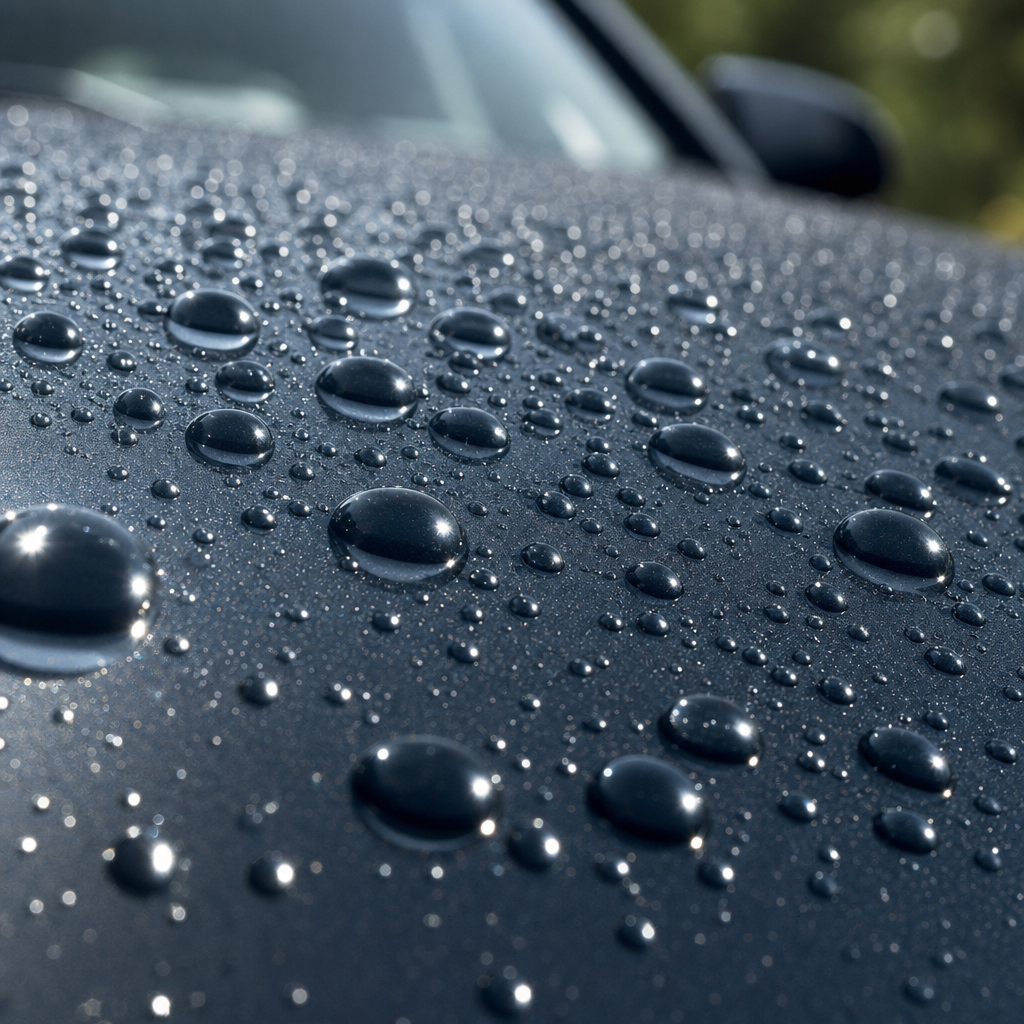
The hydrophobic effect is the property most drivers notice first. Water sheets off a coated surface in contact angles exceeding 100 degrees, meaning rain and wash water carry surface contamination away rather than leaving it sitting on the paint. For vehicles driven daily through Chicagoland's dirty winters, this property alone pays dividends every single week.
Why the Chicago Suburb Climate Makes Ceramic Coating Especially Valuable
Illinois is not a mild-weather state for automotive paint. Glendale Heights and the surrounding DuPage County suburbs expose vehicles to a genuinely hostile combination of environmental stressors across all four seasons. Understanding this context matters because it changes the value calculation significantly compared to someone in Arizona or Florida asking the same question.
Winter Road Salt and Chemical Exposure
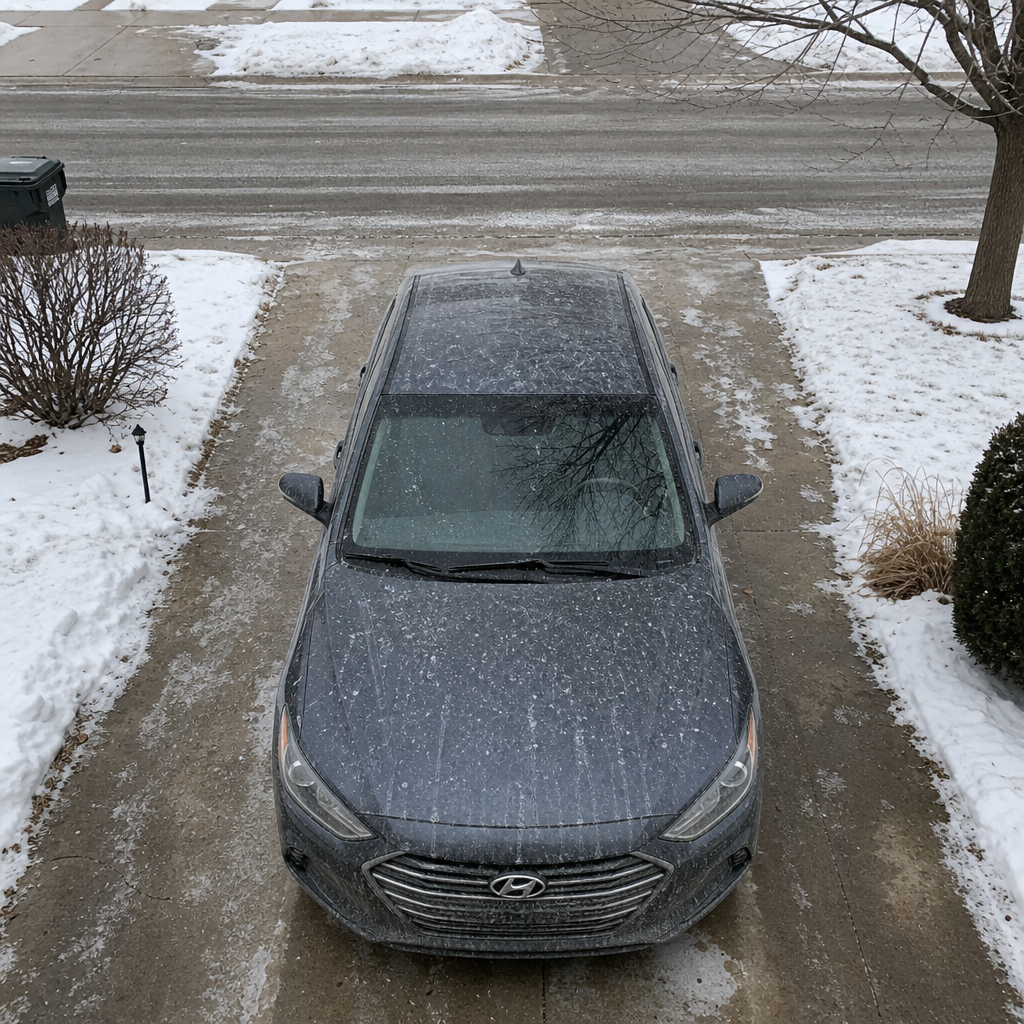
The Illinois Department of Transportation applies millions of pounds of road salt and chloride-based deicers to Cook and DuPage County roads every winter season. That salt spray coats the undercarriage, rocker panels, and lower body panels of every vehicle driven on those roads. Without a hardened chemical-resistant barrier, those chlorides accelerate oxidation and, in older or poorly maintained paint, can begin attacking the metal beneath. Ceramic coating Glendale Heights IL clients who maintain proper wash schedules during winter see dramatically less chemical etching on lower body panels compared to uncoated vehicles.
Summer UV and Industrial Fallout
Illinois summers deliver prolonged UV exposure that causes clear coat oxidation and color fading, particularly on darker vehicles. The industrial corridor along I-55 and I-290 also deposits airborne ferrous fallout on vehicles parked outdoors in suburbs like Carol Stream and Bloomingdale. This metalite contamination embeds in unprotected paint and causes orange rust speckling on light-colored vehicles. A properly applied SiO2 coating resists fallout adhesion and makes decontamination washing far more effective during annual maintenance appointments.
Freeze-Thaw Cycling and Thermal Stress
The repeated cycling between sub-zero temperatures in January and 90-degree days in July creates thermal expansion and contraction stress on paint surfaces. Ceramic coatings, because they are flexible at the molecular level while remaining chemically hard, handle this thermal cycling without cracking or delaminating. This is a meaningful advantage over older paint sealants, which can shrink and fail at seams and edges through repeated freeze-thaw cycles.
Pro tip: If your vehicle sits outside overnight in winter, schedule a ceramic coating application in early fall before salt season begins. Coating adhesion requires dry conditions above 50 degrees Fahrenheit, and a fall application means your protection is fully cured before the first December road treatment in DuPage County.
SiO2 Ceramic Coatings Explained: What You Are Actually Buying
The term ceramic coating has become so broadly used that it now describes products ranging from legitimate professional-grade nano-ceramic formulas to heavily marketed consumer sprays that contain trace amounts of SiO2 and offer minimal durability. Understanding the difference matters before you make any decision about hydrophobic paint protection in Illinois.
Professional-grade nano-ceramic SiO2 coatings contain silicon dioxide concentrations typically in the range of 85-93 percent by formulation weight. They are designed to be applied in controlled environments, require specific temperature and humidity conditions during cure, and need significant surface preparation to bond correctly. The cure time for a full professional application ranges from 24 to 72 hours under ideal conditions before the vehicle should be exposed to water.
Consumer spray-on products marketed as ceramic coatings typically contain between 5 and 20 percent SiO2 in a carrier solution. They are easier to apply because the formula is heavily diluted, but that dilution means significantly less cross-linking and bonding with the clear coat. In the real-world testing conducted by professional detailers, most consumer ceramic spray products begin degrading within 3-6 months of application under Chicago weather conditions.
"The single biggest consumer mistake we see is clients who have applied a spray-on ceramic product themselves and assume they have the same protection as a professional coating. The products share a name but almost nothing else." - A common observation among professional detailers with more than five years of coating installation experience.
At Hersheys Detailing, the coatings applied carry 5-8 year warranties backed by the coating manufacturer, not just the installer. That warranty structure is only possible with professional-grade formulations and certified installation processes.
Gyeon, Gtechniq, and Koch Chemie: How Professional Coating Brands Compare
When evaluating professional ceramic coatings, three brand names consistently appear in serious installer conversations: Gyeon, Gtechniq, and Koch Chemie. Each takes a distinct approach to ceramic formulation and installer certification. Here is a direct comparison of how they differ in the context of a Chicago-area application.
Brand | Key Characteristics | Typical Warranty Duration |
|---|---|---|
Gyeon | Korean-engineered SiO2 formulas with a modular system (base coat plus top coat options). Strong resistance to water spotting. Gyeon Q2 and Q2 Mohs are widely respected in the professional detailing community for their hardness and layerability. | 2-5 years depending on product tier; extended with maintenance programs |
Gtechniq | UK-based formulation with a strong emphasis on both hardness and self-cleaning properties. Crystal Serum Ultra, their flagship product, is widely regarded as one of the most durable consumer-accessible professional coatings available. Requires certified installer application for warranty validity. | Up to 9 years for Crystal Serum Ultra with certified installer |
Koch Chemie | German-engineered chemistry with strong industry credibility in European professional detailing markets. Known for chemical resistance and ease of maintenance washing. Their Nano Magic Ceramic range offers excellent performance in environments with high chemical exposure, which is relevant for Chicago winter driving. | 3-5 years standard; varies by product line |
In practice, the brand matters less than the installer's preparation process and application technique. A correctly applied Gyeon coating on a properly corrected and decontaminated surface will outperform a carelessly applied Gtechniq coating on an unprepared surface every time. This is why choosing a professional installer with documented preparation standards is the most important decision in the process.
Cost vs. Value: Breaking Down the Real Numbers
The question of whether ceramic coating is worth it in Illinois comes down to a straightforward cost comparison over time. Here is how the math looks for a typical luxury vehicle owner in the Glendale Heights area.
The True Cost of Not Coating
An unprotected vehicle driven year-round in DuPage County will typically require paint correction within 3-5 years due to swirl mark accumulation, water spotting, and UV oxidation. A single-stage paint correction on a luxury vehicle runs between $400 and $700. A full multi-stage correction on a heavily neglected surface can reach $1,200 or more. Add in the cost of annual wax or sealant applications at $150-$300 per visit and the annual total protection cost on an uncoated vehicle runs $250-$400 per year, with a large correction bill waiting at the end.
The Cost of Professional Ceramic Coating
A professional ceramic coating package from a certified installer in the Chicago suburbs, including proper paint correction and decontamination prep, typically ranges from $800 to $2,500 depending on vehicle size, paint condition, and coating tier. Spread across a 5-year warranty period, that equates to $160-$500 per year, with dramatically reduced maintenance requirements and no surprise correction bills.
The residual value argument is also real. Automotive research consistently shows that vehicles with documented paint protection history command higher resale prices. A well-maintained ceramic-coated vehicle with service records showing professional detailing history presents significantly better at point of sale than a comparable uncoated vehicle with faded or swirl-marked paint.
Pro tip: Ask any professional installer for a written coating specification that includes the product name, batch number, and warranty terms before committing to any package. Legitimate professional installers using manufacturer-backed products can provide this documentation. Those who cannot should not be trusted with a $60,000 vehicle.
Why Paint Correction Must Come Before Any Ceramic Coating
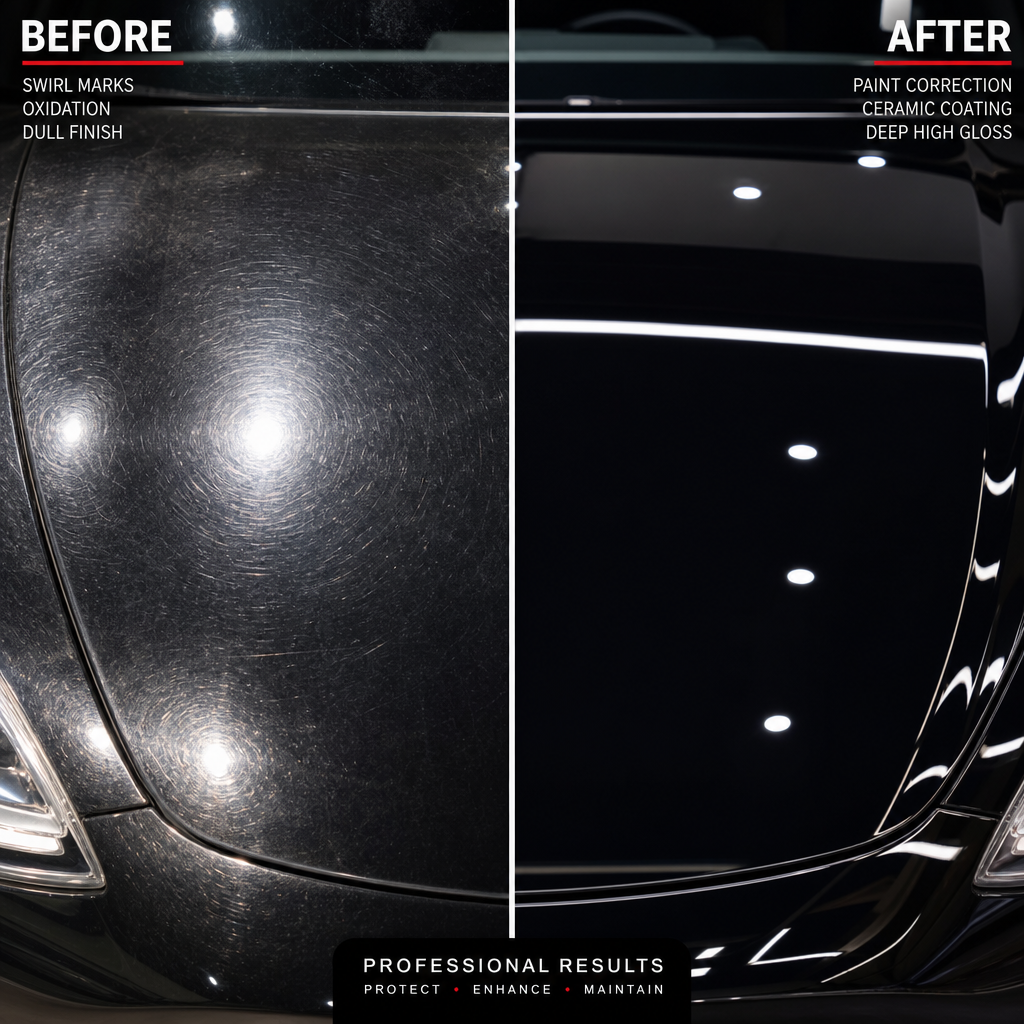
This is the point where many car owners make an expensive mistake, and it is worth being direct about it. Ceramic coating does not hide paint defects. It amplifies them. A gloss-enhancing coating applied over swirl marks, buffer trails, or oxidation will make those defects more visible under direct light, not less.
A professional multi-stage machine polishing process removes clear coat defects at the microscopic level using progressively finer abrasive compounds. Stage one removes deeper scratches and heavy oxidation. Stage two refines the surface to a high-gloss finish. Some vehicles in poor condition require a stage three finishing polish before the surface is ready for coating. Skipping or shortcutting this process is the most common way a ceramic coating installation produces disappointing results.
At Hersheys Detailing, the decontamination process before polishing includes a chemical decontamination wash, clay bar treatment to remove embedded surface contamination, and iron fallout remover to extract ferrous particles from the clear coat. This is not optional preparation. It is the foundation that determines whether the coating bonds correctly and performs as warranted.
A common mistake made by detailers who compete primarily on price is applying coating directly over a one-step polish or skipping decontamination entirely. The coating may look good for the first few weeks. By six months in a Chicago winter, the failure points become obvious.
DIY Ceramic Coating vs. Professional Application in the Chicago Suburbs
Consumer ceramic coating products have improved significantly over the past five years. There are legitimate DIY options that will provide better protection than a wax. However, the gap between consumer and professional results is substantial, and it is not primarily about the product. It is about the preparation environment and application conditions.
Professional application requires a controlled environment with stable temperature, low humidity, and zero airborne dust. Most residential garages in Glendale Heights, Bloomingdale, and Carol Stream do not meet these conditions, particularly during the spring and fall application windows when temperature swings are significant. Ceramic coating applied in sub-optimal conditions can flash unevenly, develop high spots that cure into permanent haze, or fail to bond uniformly across the panel surface.
The other variable is surface preparation. Achieving a genuinely correction-ready surface requires a dual-action or rotary polisher, multiple pad and compound combinations, and trained eyes under appropriate lighting to inspect work at each stage. These are skills developed over hundreds of vehicles, not skills acquired from a product instruction sheet.
For a vehicle worth $30,000 or more, the risk calculation for a DIY ceramic coating application is unfavorable. The savings versus professional installation are real but modest relative to the cost of repainting a panel damaged by a high-spot or improperly bonded coating section.
How to Maintain a Ceramic Coated Vehicle in Illinois
Ceramic coating dramatically reduces maintenance requirements but does not eliminate them. A coated vehicle still needs regular washing, and the washing method matters for preserving the coating's performance over its warranty period.
Wash Frequency and Method
In Illinois, a coated vehicle should be washed every 2 weeks during winter months, more frequently if the vehicle is exposed to heavy road salt accumulation. The two-bucket wash method using a pH-neutral shampoo is the correct approach. Automatic car washes with abrasive brush systems should be avoided entirely. They will not immediately damage the coating, but repeated brush contact degrades the coating surface over time and reduces the hydrophobic contact angle.
Annual Maintenance Inspections
A professional ceramic coating maintenance program typically includes an annual inspection, decontamination wash, and application of a ceramic coating booster product to refresh the hydrophobic layer. At Hersheys Detailing, the maintenance program structure is designed specifically around the Illinois seasonal calendar, with fall decontamination sessions before salt season and spring inspections after the worst road chemistry exposure of the year.
The data consistently shows that coated vehicles maintained on a professional annual program retain their hydrophobic performance ratings significantly longer than those cleaned only through consumer-level methods. Coating manufacturers who offer extended warranty periods typically require documented professional maintenance to keep the warranty valid.
For luxury and high-end vehicle owners in the Chicago suburbs, a maintenance program is not an upsell. It is the mechanism that ensures the significant upfront investment in coating protection actually delivers its full rated lifespan. Hersheys Detailing's clients in Wheaton and Bloomingdale who have maintained their coatings correctly are still seeing strong hydrophobic performance at the four and five year marks.
Frequently Asked Questions
How long does ceramic coating last on a vehicle driven through Illinois winters?
A professionally applied nano-ceramic SiO2 coating maintained with annual decontamination and inspection appointments will realistically last 5-8 years on a daily driver in the Chicago suburbs. Consumer spray-on products under the same conditions will degrade within 6-12 months. The warranty period is only meaningful if it comes from a certified installer using a manufacturer-backed product with documented maintenance requirements.
Does ceramic coating protect against rock chips from highway driving?
No. Ceramic coatings are hardened chemical barriers, not impact-resistant films. They will not prevent rock chips or deep scratches from high-velocity road debris. For protection against impact damage on high-risk zones like the front bumper, hood leading edge, and mirror caps, paint protection film (PPF) is the appropriate product. Many luxury vehicle owners in the Chicago suburbs combine PPF on high-impact zones with ceramic coating over the entire vehicle for comprehensive protection.
Can ceramic coating be applied to a vehicle that already has swirl marks?
Technically yes, but it should never be done intentionally. Swirl marks and paint defects sealed under a ceramic coating are permanent until the coating is fully removed and the paint is re-polished. The coating's gloss amplification will make existing defects more visible, not less. Any reputable installer, including Hersheys Detailing, will insist on paint correction before coating application. If an installer offers to skip correction to reduce the price, walk away.
What is the difference between a ceramic coating and a paint sealant for Illinois winters?
A paint sealant is a synthetic polymer product that bonds to the clear coat surface through adhesion rather than chemical integration. Sealants typically last 6-12 months and offer meaningful protection against UV and light chemical exposure. However, they cannot match the hardness, chemical resistance, or longevity of a professional ceramic coating. For Illinois road salt exposure specifically, the chemical resistance of a properly cured SiO2 coating provides a materially superior barrier compared to any sealant product currently available.
How do I find a legitimate professional ceramic coating installer near Glendale Heights?
Look for installers who can provide written documentation of the specific coating product being used, manufacturer certification or training credentials, a warranty document signed by both the installer and backed by the product manufacturer, and a clear explanation of the preparation process including paint correction and decontamination steps. Any installer who cannot or will not provide these specifics should be disqualified regardless of price. Hersheys Detailing serves Glendale Heights, Carol Stream, Bloomingdale, and Wheaton with full documented coating installations backed by manufacturer warranties.
Is ceramic coating worth it on a leased vehicle?
For most lease terms of 2-3 years, a full professional ceramic coating is difficult to justify on cost alone, since you will not capture the resale value benefit. However, a ceramic coating absolutely protects against the lease-end damage charges that can run $800-$2,000 for paint condition issues. If you drive a leased vehicle heavily through Chicago suburb winters, the math can work in your favor. A lighter coating package designed for shorter-term protection at a lower price point may be the better fit for a lease situation.
Have you had a ceramic coating applied to your vehicle in the Chicago suburbs, or are you still weighing whether the investment makes sense for your situation? Share your experience or questions in the comments.