If you park your car in the Chicago suburbs through a full calendar year, you already know what it costs to do nothing. Road salt from January through March. Tree sap and pollen in spring. UV glare baking your clear coat through July and August. Then the whole cycle repeats. Most car owners in Glendale Heights, Carol Stream, Bloomingdale, and Wheaton have defaulted to paste wax as their first line of defense, and most of them are quietly losing that fight. The switch to ceramic coating in Glendale Heights, IL is not a trend, it is a rational response to a climate that treats automotive paint as a consumable. This guide explains exactly why, with no fluff and no overselling.
Table of Contents
- What Wax Actually Does (And Where It Stops)
- What SiO2 Ceramic Coating Actually Does
- Chicago Suburb Climate: The Real Threat to Your Paint
- Durability and Cost: A Five-Year Honest Look
- Wax vs. Ceramic Coating: Side-by-Side Comparison
- What Professional Application Actually Involves
- Who Should Choose Ceramic Coating (And Who Should Stick With Wax)
- Frequently Asked Questions
- References
What Wax Actually Does (And Where It Stops)
Car wax, whether carnauba or synthetic, sits on top of your clear coat. It does not bond to the paint chemically. It adheres to the surface, fills minor surface imperfections temporarily, and creates a sacrificial barrier that takes the punishment from UV rays, water, and contaminants in place of your paint. That is a legitimate function, and for low-mileage weekend vehicles or classic cars kept in controlled storage, wax still makes sense.
The problem is durability. A natural carnauba wax typically lasts four to eight weeks before it degrades enough to stop protecting. A synthetic sealant does better, lasting roughly three to six months, but you are still reapplying it two to four times per year. Over five years of ownership, that adds up to somewhere between thirty and sixty wax applications. Each application requires a clean, contaminant-free surface to work correctly, and most owners skip that step, which means the wax is often locking in light contamination rather than preventing it.
The Carnauba Wax Warm Glow Problem
Carnauba wax produces a warm, amber-toned shine that looks beautiful on classic vehicles with dark single-stage paint. On modern two-stage factory paint with a clear coat, it can actually mute the depth and gloss that the clear coat is designed to show. If your car came from the factory with deep metallic flake or a candy-toned finish, you are dimming it slightly every time you apply carnauba. Synthetic sealants are neutral in tone but still cannot match the light refraction of a properly cured SiO2 ceramic coating.
Pro tip: If you are currently waxing your car and noticing water spots forming within days of a fresh application, your wax has already failed. Water spots form when minerals in water etch the surface under UV heat, and wax that has degraded offers no meaningful resistance to this process.
What SiO2 Ceramic Coating Actually Does
A nano-ceramic SiO2 coating is a liquid polymer made primarily of silicon dioxide. When applied to a properly prepared clear coat, it does not sit on the surface. It undergoes a chemical reaction with the clear coat and bonds to it, forming a hard, glass-like layer measured in microns. That layer becomes the new functional surface of your vehicle's exterior. It does not wash away with rain, car washes, or road spray the way wax does.
The practical result is a surface that is measurably harder than your clear coat alone, significantly more hydrophobic, and resistant to the chemical compounds in bird droppings, tree sap, road salt, and industrial fallout. At Hersheys Detailing, the nano-ceramic SiO2 coatings applied carry warranties of five to eight years, which tells you everything you need to know about how differently this product behaves from a wax that lasts six weeks.
Hydrophobic Performance in Real Conditions
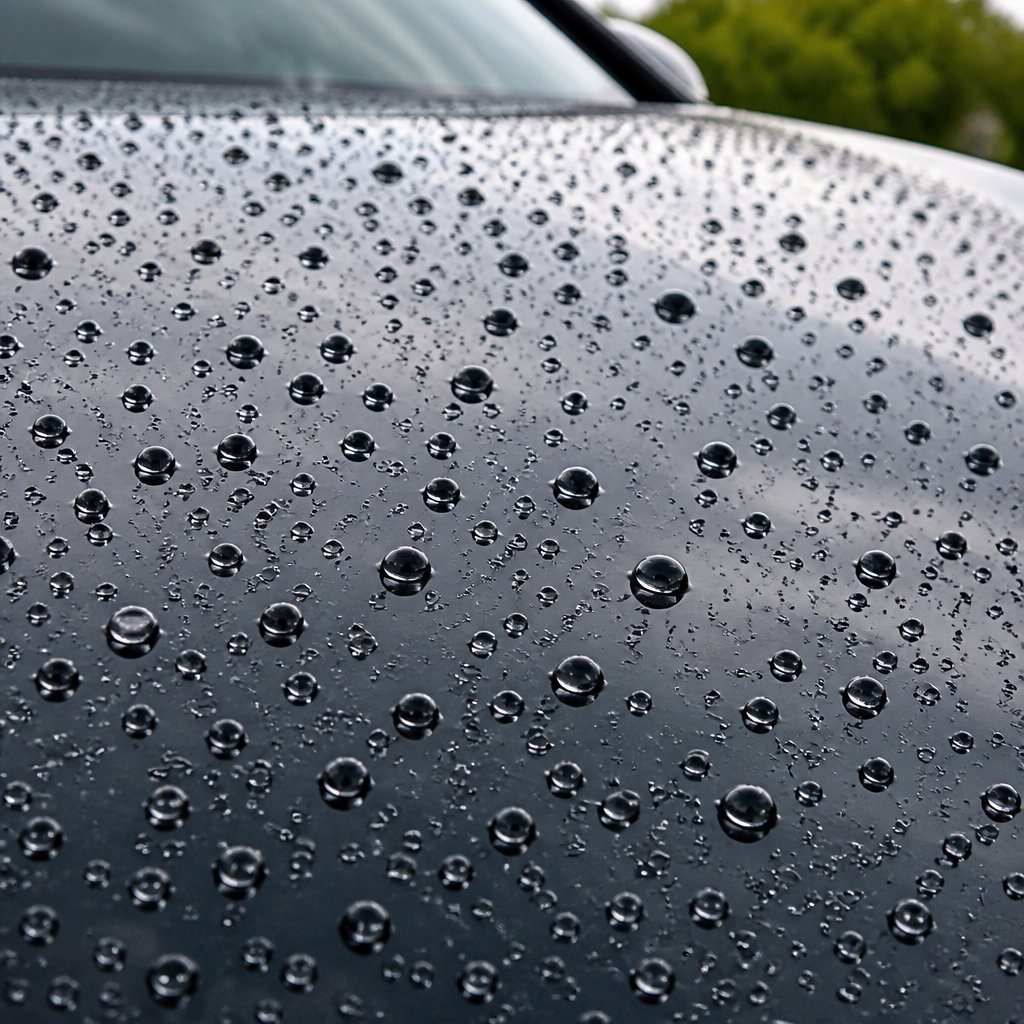
The hydrophobic car protection properties of a ceramic coating are not just about the visual effect of water beading and sheeting off the surface, though that effect is dramatic. The real benefit is that water carrying road salt, bird dropping acids, and industrial pollutants does not dwell on the surface long enough to etch into it. On a waxed surface, a water bead can sit and concentrate contaminants in one spot as the water evaporates. On a ceramic-coated surface, the contact angle is high enough that water slides off before that concentration process occurs.
Chicago Suburb Climate: The Real Threat to Your Paint
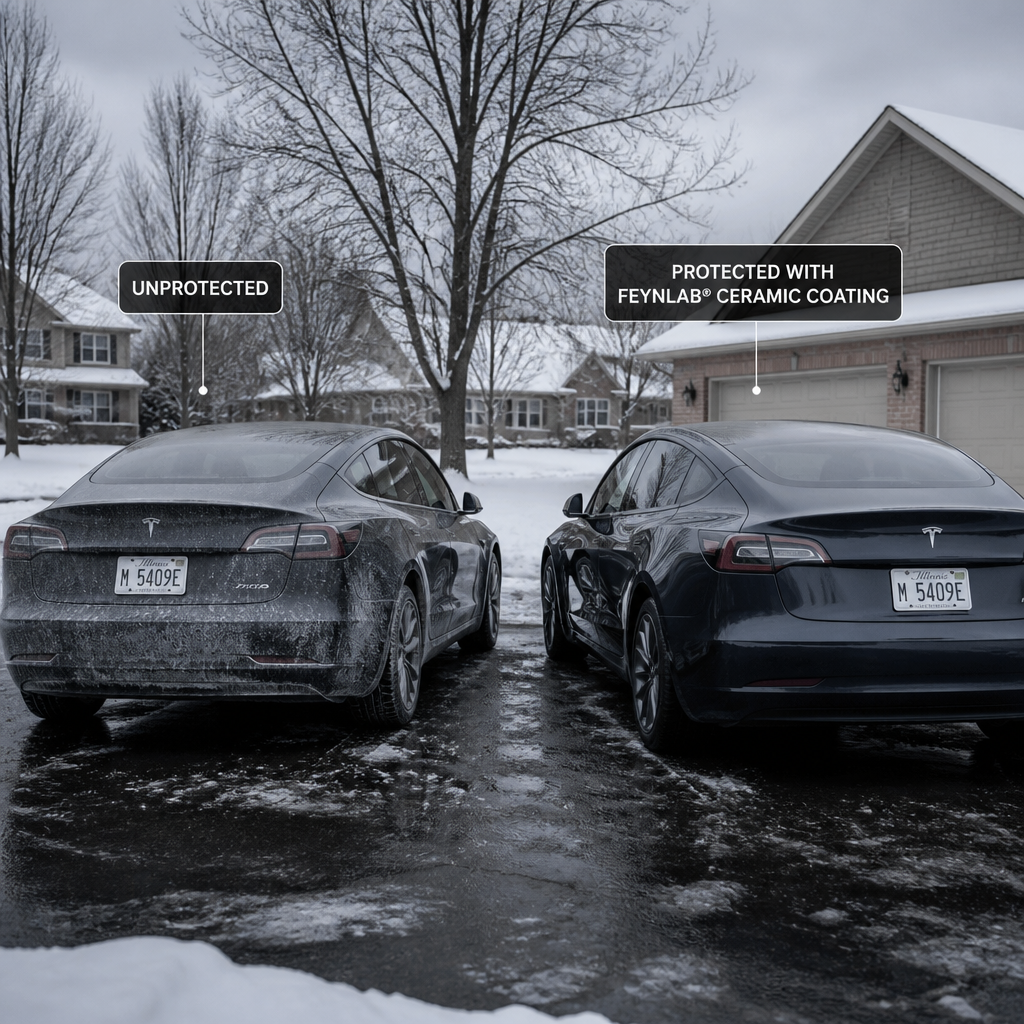
Glendale Heights, Carol Stream, Wheaton, and Bloomingdale share an identical climate threat profile: hard winters with road salt, late spring pollen seasons that deposit organic acids, summer UV exposure without coastal humidity to moderate surface temperatures, and fall with falling leaves that trap moisture. Each of these is a specific, documented mechanism of paint damage, and wax addresses exactly none of them reliably for more than a few weeks.
Road salt is the most acute problem. Illinois roads are salted aggressively from November through March, and the salt spray reaches every surface of your vehicle, not just the undercarriage. Salt is hygroscopic, meaning it attracts and holds moisture against your clear coat. On bare or wax-depleted paint, this creates a sustained chemical environment that accelerates oxidation and can begin etching into the clear coat within a single winter season.
Industrial Fallout in the Chicago Suburbs
This is the contaminant that catches most suburban car owners off guard. The Chicago metro area, including the western suburbs, has significant industrial and rail activity that deposits airborne ferrous particles onto vehicle paint. These particles embed in the clear coat and begin oxidizing immediately, creating brown-orange speckling that most owners mistake for water spots. Wax does not prevent this. Even a freshly waxed vehicle accumulates ferrous fallout within days of a detail. Ceramic coating creates a harder, smoother surface that gives these particles significantly less to bond to and makes decontamination far easier when it is needed.
Pro tip: If you run a clay bar over a waxed vehicle that feels smooth to the touch and find the clay picking up brown or gray contamination, you have iron fallout embedded in or on your clear coat. This should be addressed before any protective coating is applied, and a professional decontamination wash is the correct first step.
Durability and Cost: A Five-Year Honest Look
The sticker shock of professional ceramic coating is real. Depending on vehicle size, paint condition, and the coating tier selected, professional application runs considerably more than a can of paste wax. But the cost comparison that matters is the five-year or longer picture, not the day-one receipt.
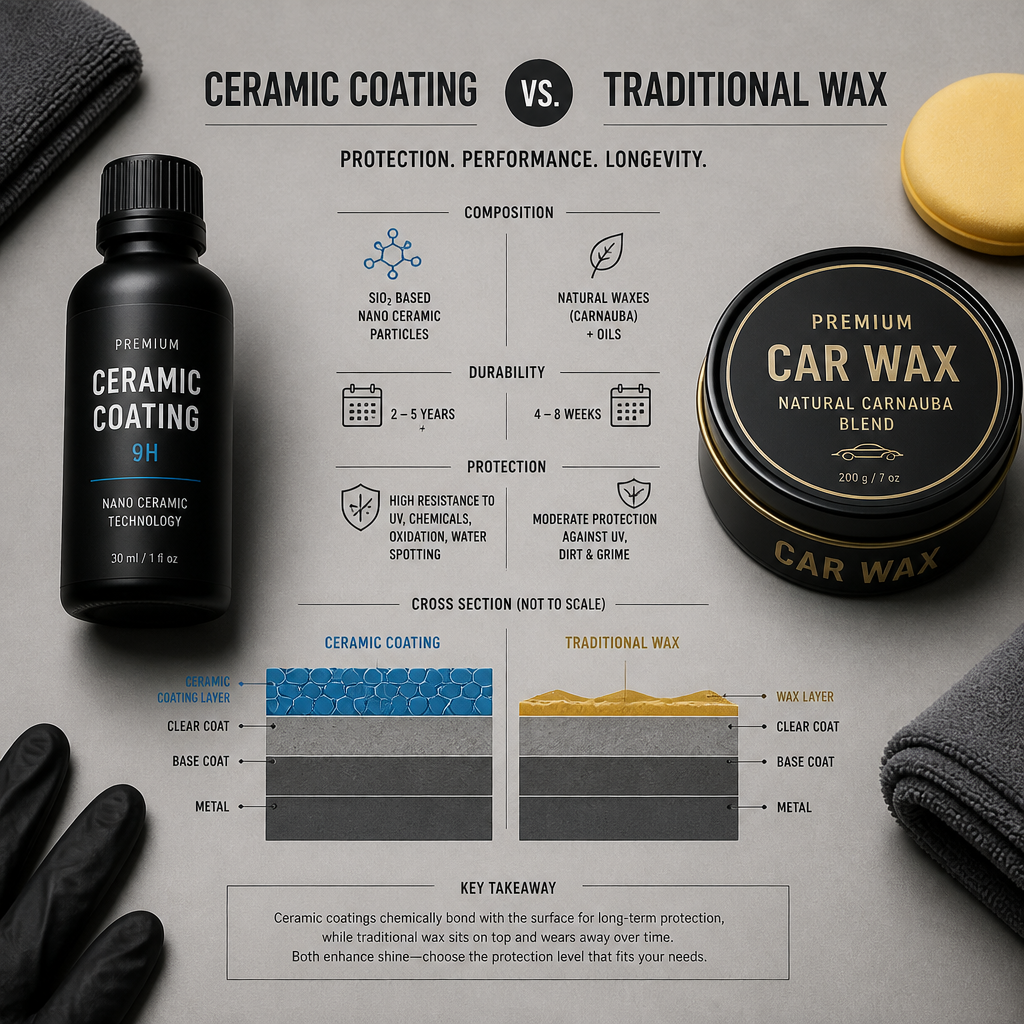
According to data from detailing industry sources, carnauba wax lasts four to eight weeks, synthetic sealants last three to six months, and professional ceramic coatings last two to five or more years, with premium coatings lasting five to seven years or beyond. Over five years, a wax-only approach requires between thirty and sixty individual applications. Each of those applications requires proper surface prep to be effective, takes two to four hours, and consumes product, applicators, and your time. The labor cost alone, whether your own time or a professional's, adds up quickly.
A professional ceramic coating from a shop with real prep standards, meaning multi-stage machine polishing and full decontamination before coating, is a single application that protects through weather cycles your wax cannot survive. At Hersheys Detailing, the prep process before coating is not a shortcut. The paint correction stage removes the swirls and oxidation that would otherwise be locked under the coating permanently. That is a precision step that defines the result.
The true cost of wax is not the $25 you spend at the auto parts store. It is the thirty hours of reapplication time and the clear coat damage that accumulates in every gap between applications over five years of Chicago winters.
Wax vs. Ceramic Coating: Side-by-Side Comparison
The table below compares wax, synthetic sealant, and professional SiO2 ceramic coating across the factors that matter most to Chicago suburb vehicle owners. These are the categories where the products diverge most sharply in real-world use.
| Factor | Carnauba or Synthetic Wax | Professional SiO2 Ceramic Coating |
|---|---|---|
| Durability | 4 weeks to 6 months depending on type | 2 to 7+ years with professional application |
| Chemical Bond | No bond, sits on surface and washes away | Chemical bond with clear coat, semi-permanent layer |
| Hydrophobic Performance | Moderate when fresh, degrades rapidly | Extreme and sustained, water sheets off the surface |
| Road Salt Resistance | Minimal, depletes within weeks of winter driving | Strong, hardened surface resists sustained salt exposure |
| UV Protection | Basic, requires frequent reapplication to maintain | Consistent UV blocking maintained across the warranty period |
| Scratch Resistance | None, wax provides no meaningful hardness | Improved surface hardness reduces light scratch and swirl risk |
| Application Complexity | DIY-friendly, no special preparation required | Requires professional prep, paint correction, and controlled application |
| Upfront Cost | Low (product cost under $50 typically) | Higher upfront investment, lower long-term cost per year of protection |
| Gloss Quality | Warm, natural glow, can mute modern clear coat depth | Deep, glass-like candy gloss that amplifies factory paint |
What Professional Application Actually Involves
One of the most common mistakes car owners make when researching professional ceramic coating near me is assuming the coating itself is the whole job. The coating is the last fifteen minutes of a multi-hour process. Everything before it determines whether the result lasts two years or seven.
The Decontamination Stage
Before any coating touches your paint, the surface must be chemically and mechanically decontaminated. This means a pH-neutral wash, an iron decontamination spray to dissolve ferrous fallout, and a clay bar or clay mitt pass to remove bonded surface contamination that washing cannot lift. Skipping this step and coating over embedded contamination is the primary reason DIY ceramic coating results disappoint. The contamination is sealed under the coating and becomes a permanent defect.
Paint Correction Before Coating
Ceramic coating is optically transparent. Any swirl mark, fine scratch, water spot etching, or oxidation present on the paint surface before coating application will be visible and permanent once the coating cures. A responsible shop does not skip paint correction before ceramic coating. At Hersheys Detailing, multi-stage machine polishing before coating is standard, not an upsell. Single-stage polish removes surface oxidation. A two-stage process corrects deeper swirls and produces the clarity that makes a ceramic coating look like liquid glass rather than a shiny but imperfect surface.
The Coating Application Window
Once paint correction is complete, the vehicle must be wiped down with a panel wipe or IPA solution to remove any polishing oils before the coating is applied. Ceramic coatings have a working window, the time between application and the point at which the coating begins to flash and cannot be leveled. Working outside that window produces high spots that are difficult to remove once cured. This is not a beginner-friendly process, and it is exactly why the DIY ceramic coating market produces so many unhappy results.
Who Should Choose Ceramic Coating (And Who Should Stick With Wax)
Ceramic coating is the right call for daily drivers in the Chicago suburbs, luxury and high-end vehicles where paint preservation directly affects resale value, and any owner who wants to stop thinking about paint protection for the next five to seven years. If you drive through Glendale Heights winters, park outside, and want your car to look as good in year three as it did at delivery, ceramic coating is the only product that can actually deliver that.
Wax still makes sense in specific, narrow circumstances. Classic vehicle owners who apply wax as part of a regular detailing ritual and appreciate the traditional process get genuine value from carnauba. Owners of inexpensive daily drivers who plan to sell the vehicle within a year or two and cannot justify the upfront investment in coating are better served by a quality synthetic sealant applied properly. And if your paint has significant damage, rust, or peeling clear coat, no protective coating of any kind is the right first step. Paint repair comes first.
The honest answer to whether ceramic coating Chicago suburbs residents are choosing over wax is: yes, and the reason is straightforward. When you drive year-round in Illinois and own a vehicle you care about, the math on durability, protection quality, and long-term cost per year of protection favors ceramic coating without a close contest.
Frequently Asked Questions
How long does professional ceramic coating last on a vehicle driven in Illinois winters?
A professionally applied SiO2 ceramic coating, with proper paint correction and decontamination prep, typically lasts two to five years at minimum, with premium coatings lasting five to seven years or more. The Illinois climate is challenging but ceramic coating was engineered specifically for sustained exposure to UV, road chemicals, and temperature cycling. The warranties offered by professional applicators like Hersheys Detailing, ranging from five to eight years, reflect real expected performance, not marketing language.
Can I apply ceramic coating over an existing wax or sealant?
No. Wax and sealant residue must be completely removed before ceramic coating is applied. Any wax or polish oil remaining on the surface will prevent the ceramic coating from bonding correctly with the clear coat, resulting in patchy adhesion, shortened durability, and potential high spots. A proper IPA wipe-down or panel wipe after paint correction is the correct preparation step.
Is the hydrophobic effect of ceramic coating really that different from a fresh wax?
Yes, and the difference is most visible within two to four weeks of application. Fresh wax produces decent water beading, but it degrades quickly, especially with exposure to road salt and car wash detergents. A cured ceramic coating maintains a consistently high water contact angle for years, meaning water does not just bead but actively sheets off the surface at low speeds. This sustained hydrophobic performance is one of the most practically useful benefits for Chicago suburb daily drivers.
Does ceramic coating prevent all scratches?
No, and any shop that tells you otherwise is overselling. Ceramic coating increases surface hardness and significantly reduces the risk of light swirl marks from washing and environmental contact. It will not prevent key scratches, rock chips, or parking lot door dings. Think of it as a layer that keeps your corrected paint in its current state more effectively, not as armor against physical impact.
Why does professional ceramic coating cost more than a DIY kit from an auto parts store?
The product itself is part of the cost difference, but the larger factor is the labor and preparation. A professional installation includes a full decontamination wash, iron fallout removal, clay bar treatment, one or more stages of machine polishing to correct paint defects, and then precise coating application in a controlled environment. A DIY kit applied without those preparation steps will not bond correctly and will not last. The preparation stage is where the durability and visual result are actually created.
How do I maintain a ceramic-coated vehicle between professional details?
Maintenance on a ceramic-coated vehicle is significantly simpler than on a waxed vehicle. A pH-neutral car wash soap, a quality microfiber wash mitt, and a two-bucket wash method are all you need for routine cleaning. Avoid automatic car washes with abrasive brushes. A ceramic coating maintenance spray can be applied periodically to top up the hydrophobic layer, but it is not a requirement in the way that re-waxing is mandatory on an uncoated vehicle. Hersheys Detailing offers maintenance programs specifically designed to keep ceramic-coated vehicles in optimal condition year-round.
If you have had a ceramic coating applied in the Chicago suburbs or recently made the switch from wax, share what your experience has been through an Illinois winter - your real-world feedback helps other car owners make a better-informed decision.
References
- Expert comparison of car wax versus ceramic coating covering durability, cost, and protection levels
- Detailed guide comparing ceramic coating and wax across durability, long-term cost, and real-world performance
- Pros and cons breakdown of ceramic coating versus wax to help vehicle owners choose the right paint protection