Ask ten car owners what paint correction means and you will likely hear ten different answers. Some think it is a wax with extra shine. Others picture a quick buff on the hood before a sale. In practice, full vehicle paint correction in Illinois is a planned, panel-by-panel process that removes defects from the clear coat, not a cosmetic cover-up. At Hersheys Detailing in Glendale Heights, we treat a full vehicle as a sequence of decisions, not a single machine pass. Here is how that sequence works and where it usually goes wrong.
Table of Contents
- Quick Takeaways
- Inspecting Every Panel Before the First Pass
- Decontamination Before Any Machine Touches Paint
- Masking, Setup and Panel Mapping
- Panel-by-Panel Machine Polishing Sequence
- Comparing Single-Stage, Multi-Stage and Spot Correction
- Protecting the Corrected Finish With Ceramic Coating
- Timing Correction Around Chicago Suburb Seasons
- Frequently Asked Questions
- References
Quick Takeaways
| Key Insight | Explanation |
|---|---|
| Inspect before you polish | Map each panel's defects under daylight and a handheld light before choosing a pad or compound. Write down what you find so the plan is based on the car, not a guess. |
| Decontaminate first | Iron fallout, tar and road grime left on the paint load polishing pads and create new hairline marks during correction. |
| Work one panel at a time | Finish a panel, inspect it under the same light, then move on. Jumping between panels leads to uneven gloss and missed defects. |
| Cut only as deep as needed | Use the least aggressive pad and compound combination that removes the defect, because clear coat is a finite layer you cannot add back. |
| Refine before you protect | Refinement clears the haze left by cutting. Sealing or coating over haze locks it in permanently. |
| Time the job before salt season | A corrected, decontaminated surface gives protection a clean bond. Finishing before the first winter salt is the smartest window in the Chicago suburbs. |
Inspecting Every Panel Before the First Pass
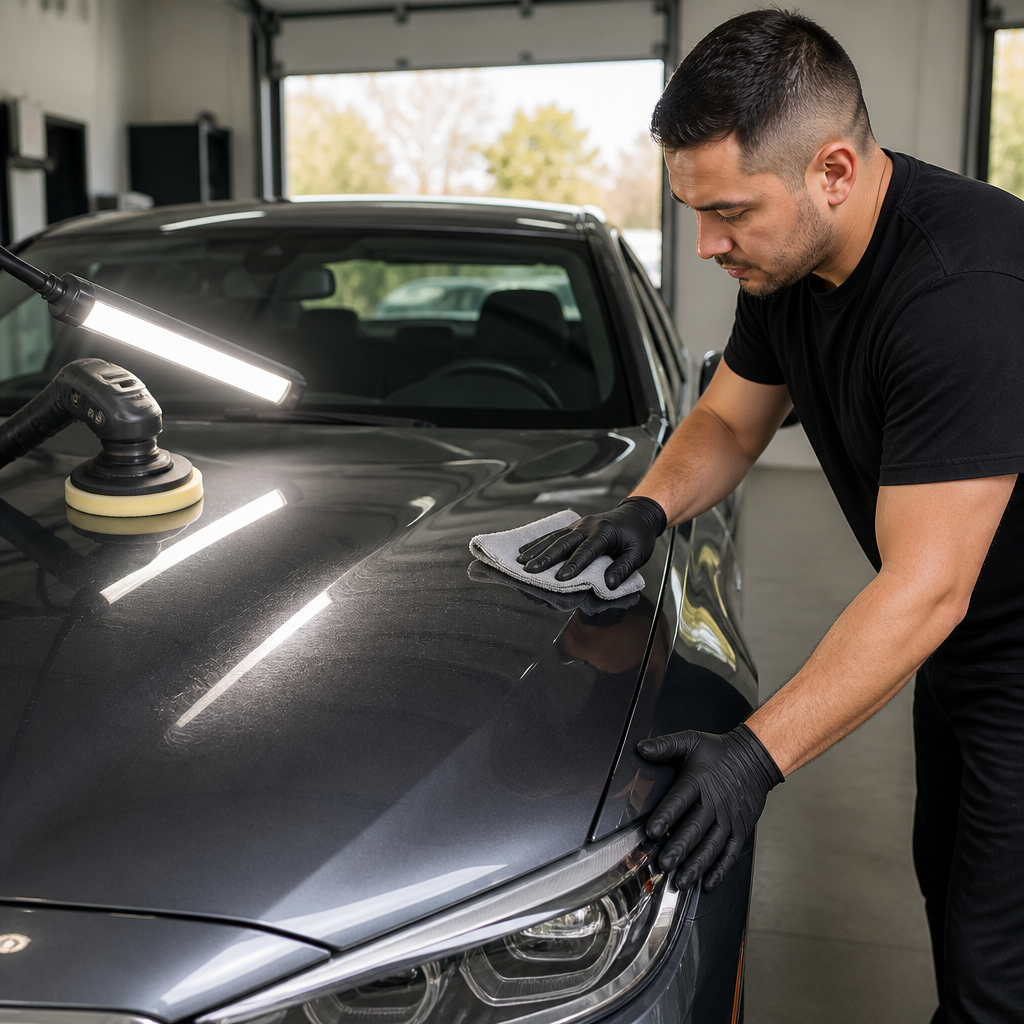
The first hour of a full correction happens without a polisher in hand. We walk the car in daylight, then under a handheld LED light, and mark every panel that shows swirls, water spots, etching or deeper scratches. On cars with a repaint history, we also check paint thickness, because the amount of clear coat left determines how much correction is safe.
Lighting and What Each Light Reveals
Overhead shop lights hide swirls, while direct, low-angle light makes them obvious. A common mistake is inspecting a car in the same bay where it was washed, with the sun behind the panel. We move the car, and the light, until the defects show clearly.
Recording Defects Panel by Panel
We note the location, defect type and rough depth of every problem on a diagram of the vehicle. Scratches that catch a fingernail are usually beyond what polishing can safely remove, and we say so before any work begins. Owners should hear that on day one, not after the car is half finished.
Most of the work in paint correction happens before the machine starts. A written plan prevents the most expensive mistake in detailing, which is removing more clear coat than the car needed to lose.
Pro tip: Photograph each panel under the same light before you start. Those reference photos are the only honest proof of improvement when the car is delivered.
Decontamination Before Any Machine Touches Paint
Polishing pads work like sandpaper with a soft backing. If bonded contamination is still on the paint, the pad drags it across the surface and creates new marks. Decontamination is what makes the rest of the job predictable.
Chemical Decontamination and Iron Removal
Iron particles from brake dust settle into the clear coat and show up as orange specks after a wash. An iron remover reacts with those particles and lifts them without rubbing. We rinse thoroughly before moving on, because residue left on the paint dries into the next stage and gets in the way of inspection.
Clay Bar Work and Knowing When to Drop the Clay
Clay removes what chemistry cannot, including tree sap, overspray and grime bonded to the surface. We use plenty of lubricant, fold the clay often and check the paint by touch after each section. A clay bar that picks up grit gets retired, not reused, because a dropped bar can scratch the next panel.
Why Winter Residue Needs Its Own Pass
Cars that spend a Chicago winter on salted roads carry a film of road salt and brine that hides in lower panels, rocker areas and wheel wells. That residue needs a thorough rinse and a dedicated chemical pass before any mechanical step. Skipping it is one of the fastest ways to turn a good correction into a scratched one.
Masking, Setup and Panel Mapping
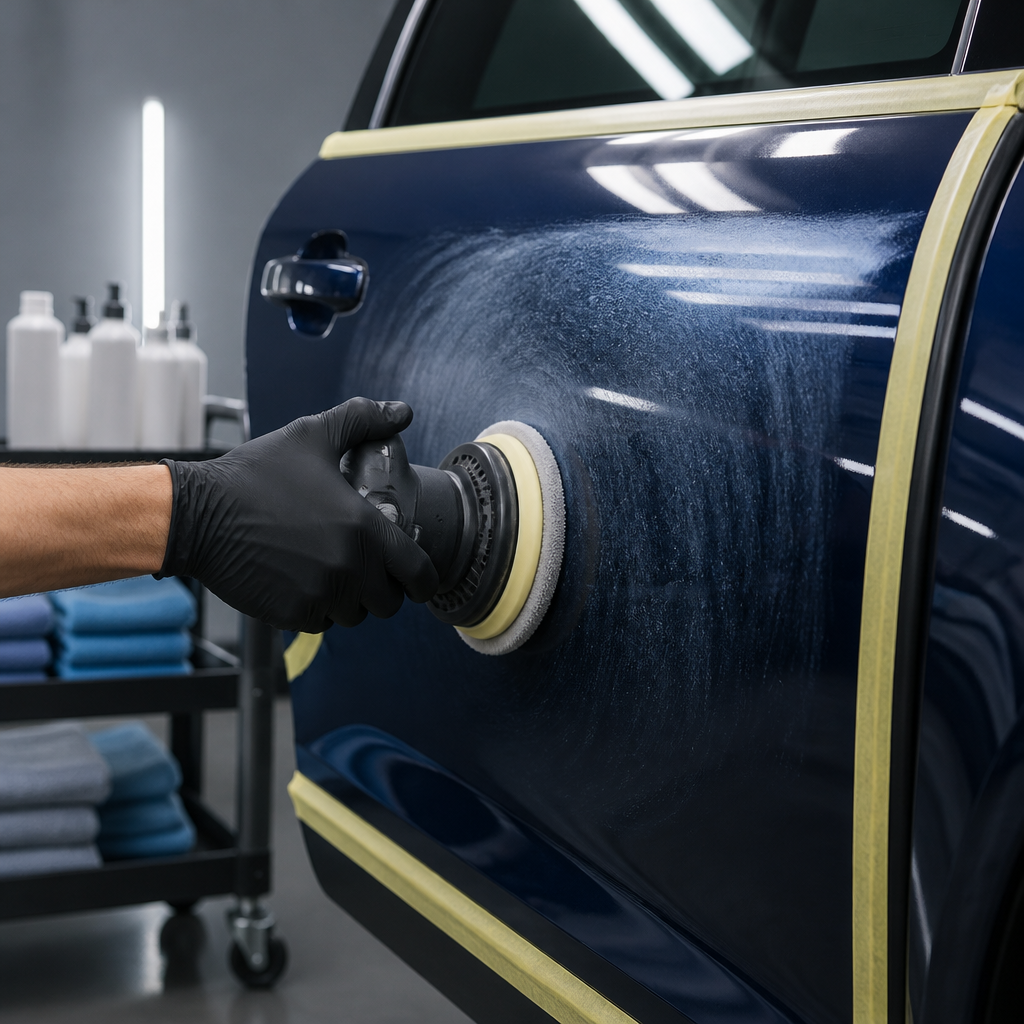
Setup determines whether the polishing goes smoothly. We mask plastic trim, badges, rubber seals and sharp body edges with painter's tape, because compound and polish can stain or dull them. Masking takes time, and it is the step most often skipped when a shop is chasing a fast turnaround.
Masking Edges, Trim and Emblems
Tape should overlap the boundary by a few millimeters, not sit on the paint itself. Emblems and badges get masked even when they look solid, because compound collects in the grooves and dries into a haze that is hard to clean. Matte and textured black trim needs extra care, since heavy cutting can leave it looking blotchy.
Dividing the Car Into Working Zones
We work the vehicle in fixed zones, usually the hood, then the roof, then one side, then the other, with doors and quarter panels handled as separate units. Each zone gets its own pad set and an inspection before we move on. Lighting is repositioned for each zone so the defects show at the correct angle, which keeps us from losing track of which areas have been cut.
Panel-by-Panel Machine Polishing Sequence
Machine polishing is where the finish changes. On every panel, the sequence is cut, refine, then inspect. Skipping a stage does not remove the problem, it only moves the problem into the next stage where it is harder to see.
Cutting Stage on Hoods and Roofs
Cutting uses the most aggressive pad and compound combination that removes the defect. Hoods and roofs get the most sun and usually show the heaviest oxidation. We keep the pad flat, use light pressure, work small sections with overlapping passes and wipe the residue to check progress.
Refinement Stage and Pad Selection
Refinement uses a finer pad and polish to remove the haze left by cutting. Pad condition matters more than most owners realize, because a worn or contaminated pad cuts unevenly. We keep separate pads for cutting and finishing and never move a pad from one compound to another without cleaning it first.
Pro tip: Number each pad with a marker after every use so you always know which compound it was loaded with and how many passes it has seen.
Edges, Body Lines and Emblems
Body lines and panel edges hold less clear coat than flat surfaces. Burning through an edge is one of the costliest mistakes in correction, so we reduce speed, use a smaller pad and check the edge under light after every pass. If an edge looks thin, we stop and reassess rather than pushing through.
Comparing Single-Stage, Multi-Stage and Spot Correction
Not every car needs the same depth of correction. A car in good condition may only need a single-stage polish, while a neglected dark finish needs a full multi-stage approach. The table below shows how we compare the common options and where each one fits.
| Approach | Best Use | Trade-Off |
|---|---|---|
| Single-stage polish | Newer cars with light swirls and healthy gloss | Limited depth, so deeper scratches usually remain visible |
| Multi-stage correction (cut, refine, protect) | Dark paint, oxidized panels and cars headed for ceramic coating | Longer labor time and a higher skill requirement |
| Spot correction | One or two damaged panels on an otherwise healthy car | Color and gloss mismatch if neighboring panels are not blended |
When One Stage Is Enough
A single-stage polish is honest work for a car that already looks good. If the paint shows light swirls and the owner mainly wants a richer shine, a well-chosen polish and pad can deliver a clear improvement. We say so when that is the right call, even though a larger job would be more profitable for us.
Why Multi-Stage Is the Default for Dark and Luxury Finishes
Dark paint, especially black and deep metallic colors, shows every mark under the sun. Many luxury vehicles also carry a clear coat that is thinner than owners expect, which limits how much cutting is safe. For those cars, a multi-stage process with inspection between stages is the only way to get a result that holds up in direct light.
Spot Correction and the Blending Problem
Spot correction makes sense when one door or bumper is damaged and the rest of the car is in good shape. The risk is blending. If the repaired panel is polished harder than its neighbors, the gloss and color depth will not match, and the difference shows most in the afternoon sun.
Protecting the Corrected Finish With Ceramic Coating
A coating only bonds to the surface you give it. Coating over unrefined haze locks the haze in, which is why we never apply a coating to a panel that has not passed inspection. Protection comes last in the sequence for that reason.
Why Preparation Determines Coating Lifespan
Our nano-ceramic SiO₂ coatings carry 5 to 8 year warranties, and those warranties assume the surface was fully decontaminated and corrected before application. A coating does not hide defects. Anything left behind stays visible under the new layer, and it can look worse once the gloss is deeper.
Maintenance That Protects the Investment
After coating, owners should wash with a pH-neutral soap, avoid automatic brush washes and use a clean drying towel instead of a squeegee. Harsh strippers and some wheel cleaners can degrade coated surfaces over time. A scheduled maintenance wash keeps the coating working the way it was designed to.
Timing Correction Around Chicago Suburb Seasons
October is a strong window for paint correction in the Chicago suburbs. Cars that have spent the summer on busy commuter corridors have collected tree sap, bug residue and road grime, and they need decontamination and inspection before the cold arrives. Protection should follow before road salt season begins.
Owners in Glendale Heights, Carol Stream, Bloomingdale and Wheaton often bring in vehicles that have been parked outside for months. That exposure shows up on hoods, roofs and lower panels. Booking in early fall leaves room to finish the work before the weather turns.
Scheduling a Full Correction Before Winter
A full multi-panel correction is a multi-day job on a neglected vehicle, and a car in good condition still takes most of a day. Scheduling in early fall protects you from a rushed job in November. If the weather turns, a pushed date costs far less than a rushed polish.
Working in Cold Garages and Cold Paint
Cold paint and cold garages change how compounds and polishes behave. Products can become stiff, and the paint itself responds differently to pressure. We bring the vehicle indoors and let it reach a stable temperature before starting, which keeps the results consistent from one panel to the next.
Frequently Asked Questions
How long does full vehicle paint correction take?
A full multi-panel correction usually takes most of a day for a car in good condition. Heavily swirled paint takes longer because every panel passes through cutting, refinement and inspection before it is considered finished.
Does paint correction remove every scratch?
No. Polishing removes defects within the clear coat. Scratches that cut through the clear coat into the base color or primer can be reduced but usually cannot be erased without repainting that panel.
Will paint correction make my car's clear coat thinner?
Correction removes a small amount of clear coat, and that is the trade-off of the process. Good technique removes only what the defect requires, and inspection with proper lighting prevents unnecessary overwork.
Is multi-stage polishing worth it for a daily driver?
For most daily drivers, a light single-stage polish is enough if the paint is in good shape. A multi-stage correction pays off when the paint is dark, oxidized or about to receive a ceramic coating.
Why choose a panel-by-panel process over a quick buff?
A quick buff often leaves uneven gloss between panels and misses defects that only show under low-angle light. Working one panel at a time with inspection between stages gives a consistent result across the whole vehicle.
Can paint correction be done during a Chicago winter?
Garage work is possible, but cold paint and cold garages change how products behave. Scheduling the work in the fall keeps the job on track and gives the finish protection before road salt season.
Tell us about your experience with paint correction, whether you had it done or tried it yourself, and what surprised you most about the results.
We would love your feedback and any insights you would share with others. What perspective would you add?