You've seen the videos: water pearling into tight beads and rolling off a car's hood like it's repelled by magic. It's compelling. And it's also the most misunderstood part of modern paint protection. Plenty of vehicle owners in the Chicago suburbs invest in a hydrophobic car coating in Illinois expecting their car to stay clean between washes. That expectation is partly right and partly a marketing fiction that sets people up for disappointment. Before you commit to a coating, or before you question why your coated car still gets dirty, this guide explains exactly what self-cleaning paint protection does, what it doesn't do, and what it actually takes to make the chemistry work in a place like Glendale Heights, where road salt, freeze-thaw cycles, and summer humidity all compete to degrade your investment.
Table of Contents
- Quick Takeaways
- What Hydrophobic Actually Means in Paint Protection
- The Self-Cleaning Effect: The Truth Behind the Claim
- Water Beading vs. Water Sheeting: Which One Matters More
- SiO2 Ceramic Coating Chemistry: Why Silicon Dioxide Dominates
- Illinois Winters and Hydrophobic Coatings: A Real-World Test
- Comparison of Hydrophobic Protection Options
- What Professional Application Actually Changes
- Frequently Asked Questions
- References
Quick Takeaways
| Key Insight | Explanation |
|---|---|
| Hydrophobic does not mean self-cleaning | Water beading reduces surface contact with moisture but does not replace washing. Dirt, pollen, and industrial fallout still accumulate and must be removed. |
| Water beads can cause water spots | Beads that sit on a surface in direct sun evaporate and leave mineral deposits. Tight, fast-rolling beads on a properly applied SiO2 coating minimize this risk, but don't eliminate it entirely. |
| Consumer SiO2 sprays are not the same as professional ceramic coatings | Retail spray sealants typically last 6 to 12 months under normal conditions. Professional multi-layer ceramic coatings chemically bond to paint and are engineered to last years, not months. |
| Paint prep determines coating performance | A ceramic coating applied over contaminated, swirled, or oxidized paint locks those defects in permanently. Decontamination and paint correction are not optional extras - they are prerequisites. |
| Road salt accelerates coating wear in Illinois | Chicago-area winters impose a real chemical load on any paint protection layer. Professional-grade coatings that chemically bond to paint are far better equipped to survive freeze-thaw cycles and salt brine than wax or spray sealant. |
| Sheeting can outperform beading in wet conditions | A surface where water sheets off in a single mass leaves less residue than one where dozens of small beads cling momentarily. The best professional coatings produce tight beads that quickly merge and sheet away. |
| Warranty length only matters if the prep and application are correct | A 5-year or 8-year ceramic coating warranty is meaningless if the coating was applied over uncorrected paint or without proper panel prep. Application environment and process matter as much as the product itself. |
What Hydrophobic Actually Means in Paint Protection
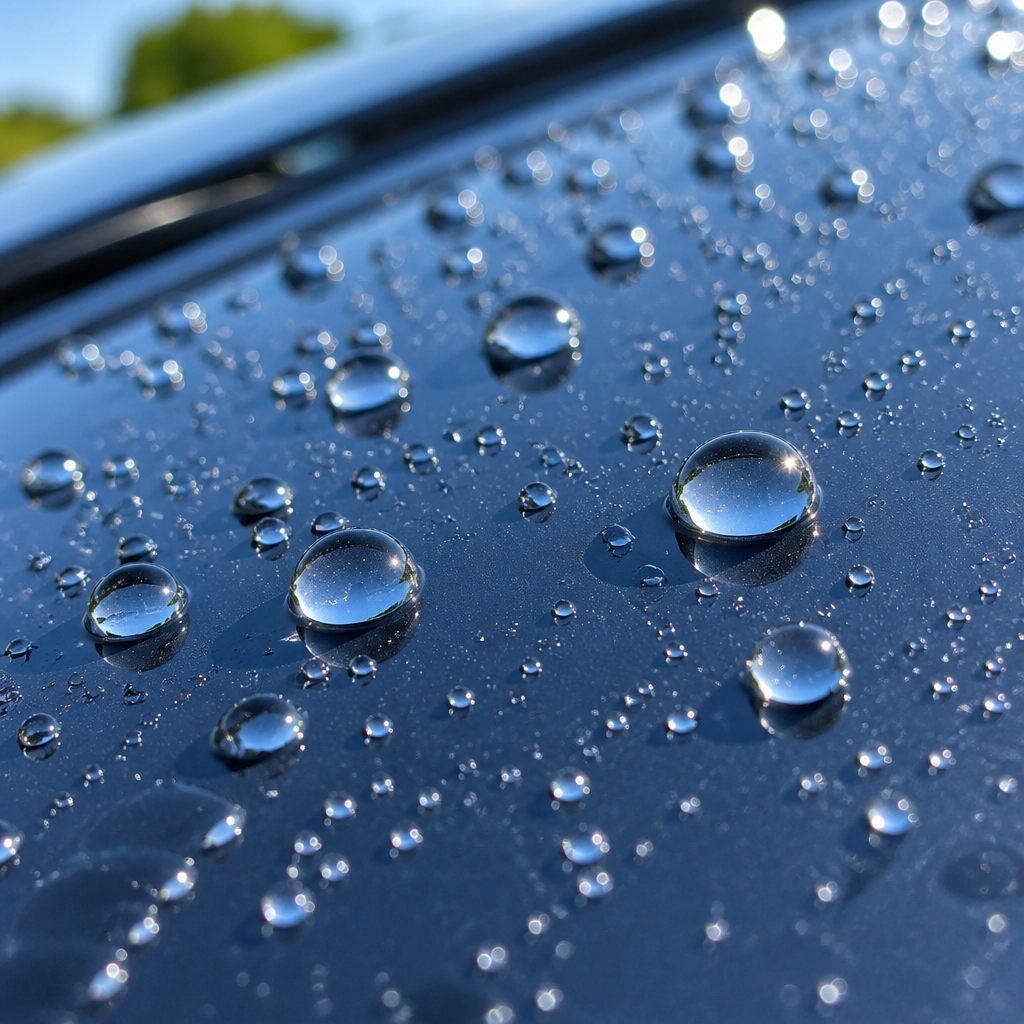
The word hydrophobic comes from the Greek for "water-fearing," and in coating science it describes a surface that repels water rather than attracting it. On a practical level, this means water molecules cannot spread across the surface. They pull together into droplets, forming what's called a high contact angle, typically above 90 degrees on a properly coated panel. The higher that angle, the less contact the water has with the paint beneath it.
This matters because water is rarely just water on a car. Rainwater carries dissolved minerals, road film, and industrial particulates. When water sits on bare or poorly protected paint and evaporates, it leaves those contaminants behind as etching, mineral deposits, or water spots. A hydrophobic surface minimizes the time and surface area that water spends in contact with your paint, which reduces, though does not eliminate, the damage potential of each rain event or wash cycle.
What hydrophobic does not mean is self-cleaning in any absolute sense. Dry dust, brake dust, tree sap, bird droppings, and industrial fallout are not water-soluble in the first place, so a surface that repels water offers limited defense against them. A coated car still gets dirty. It gets dirty differently, and it cleans more easily, but claiming a coated car "cleans itself" is a simplification that sells coatings and confuses expectations.
The Self-Cleaning Effect: The Truth Behind the Claim
The self-cleaning claim is not invented out of nothing. There is a real mechanism behind it. When water beads up on a hydrophobic surface and rolls off, it does carry some loose contaminants with it, particularly dust and light road film that hasn't bonded to the surface. This is sometimes called the "lotus effect," named after the lotus leaf whose microscopic surface structure causes water to bead up and roll away, taking debris with it.
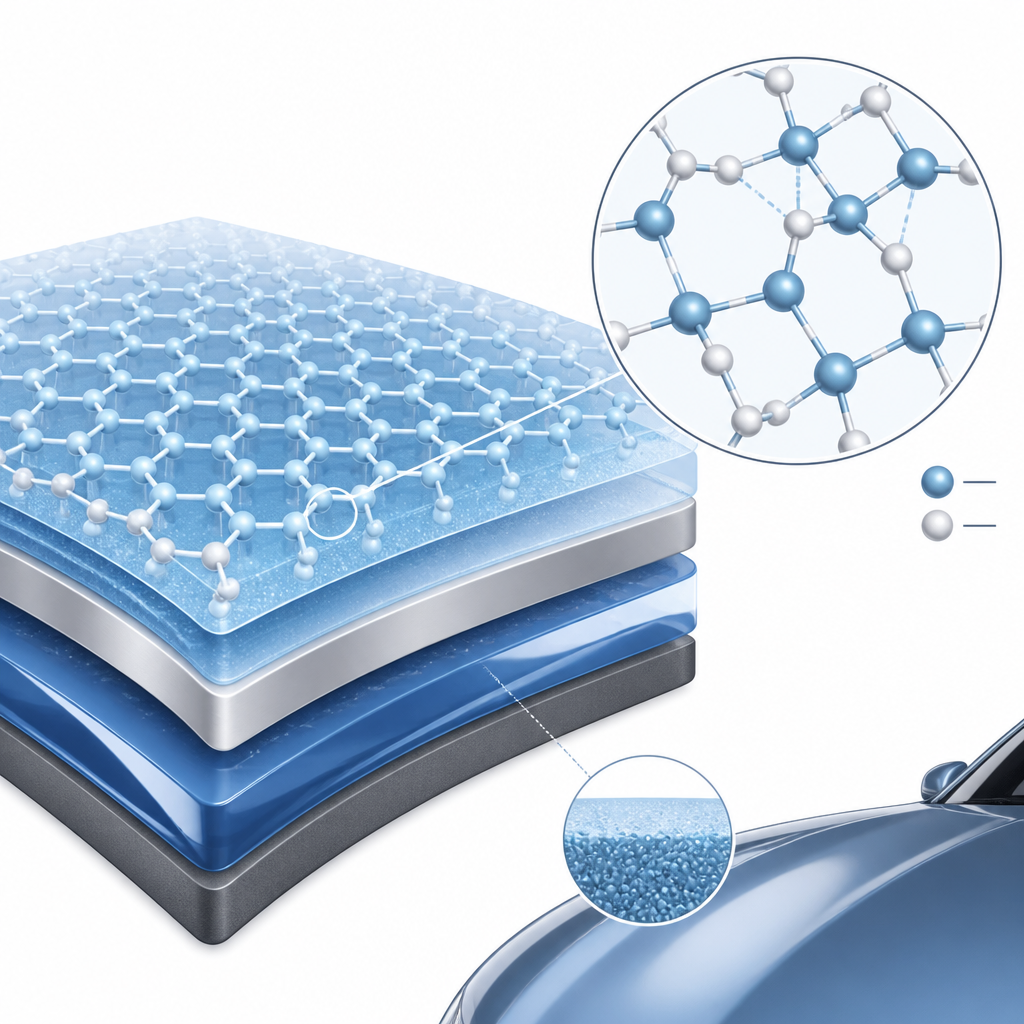
On a nano-ceramic SiO2 coating, the chemistry produces a similar result. The silicon dioxide matrix creates a densely cross-linked surface that is chemically slippery. Loose surface contaminants bond weakly to it, so the rolling water bead picks them up on its way down the panel. In a light rain shower, this does genuinely reduce how much fine dirt accumulates compared to uncoated paint. That is the honest version of the self-cleaning story.
The dishonest version, or at least the wildly overstated version, is that a coated car never needs washing. It does. Heavier contamination, including bug splatter, bird droppings, and tree sap, can chemically etch a ceramic coating if left long enough. The coating makes decontamination far easier, but it does not replace maintenance. Treating a coated car as maintenance-free is the fastest way to void the protection those coatings were designed to provide.
Water beading looks impressive, but it is not proof of protection. Many hydrophobic substances bead water dramatically and provide zero durable paint protection. What matters is chemical bond strength, surface hardness, and longevity, not just the bead shape in a photo.
Water Beading vs. Water Sheeting: Which One Matters More
This is one of the most debated points in the detailing world, and it deserves a direct answer. Water beading and water sheeting are two different physical behaviors, and they have different implications for paint protection.
How Water Beading Works on a Coated Surface
Water beading occurs on hydrophobic surfaces where the contact angle is high enough that water molecules pull together into discrete drops rather than spreading out. On a quality SiO2 ceramic coating, these beads are tight, nearly spherical, and roll off the panel quickly. The key word is quickly. A bead that rolls immediately takes dirt with it and leaves minimal residue. A bead that sits stationary on the paint in direct sun will evaporate and deposit its mineral load directly on the coating surface, causing the water spots that frustrate coated-car owners who expected perfection.
How Water Sheeting Works and When It's Better
Water sheeting happens when individual beads merge and flow off the surface as a single moving sheet rather than as individual drops. This is actually the more desirable behavior in many situations because a sheeting surface leaves less water behind after a rain or rinse. Fewer water droplets means fewer opportunities for water spots to form. The challenge is that truly hydrophilic sheeting coatings used in commercial and medical industries are not practical for automotive paint. Instead, the best professional ceramic coatings produce tight beads that quickly coalesce and sheet away, giving you something closer to the benefits of both behaviors.
If you are evaluating a coating by its bead shape alone, you are evaluating it incorrectly. The real indicators of a quality hydrophobic coating are how fast the beads roll at a low angle, how clean the surface stays between washes, and how long the behavior persists over months and years of real-world driving.
SiO2 Ceramic Coating Chemistry: Why Silicon Dioxide Dominates
The chemistry behind professional ceramic coatings in the Chicago market is dominated by silicon dioxide, the same compound found in quartz and glass. When a SiO2 coating in Glendale Heights or anywhere else is professionally applied, it does not simply sit on top of the paint like a wax. The liquid polymer forms a covalent chemical bond with the clear coat at the molecular level, creating a semi-permanent protective layer that becomes part of the surface rather than a coating on top of it.
This chemical bonding is what separates professional ceramic coatings from spray sealants sold at auto parts stores. Consumer-grade SiO2 spray products provide a thin hydrophobic film that typically lasts six to twelve months under normal conditions and can be depleted significantly faster in environments with heavy road salt exposure. They apply easily, they do bead water, and they offer some short-term protection, but they lack the thickness, cross-link density, and surface hardness of a professionally applied multi-layer system.
What 9H Hardness Actually Means for Your Paint
Professional-grade ceramic coatings are often described with a hardness rating, and 9H is the figure most commonly cited. This refers to pencil hardness testing, a standardized method for measuring surface hardness. A 9H rating means the cured coating surface resists scratching from a 9H pencil, which represents the hardest grade on the standard pencil hardness scale. This level of surface hardness provides meaningful resistance to fine scratches, swirl marks from improper washing, and light abrasion from environmental contact. It does not mean the coating is scratch-proof. A sharp rock, a careless key, or aggressive abrasive polishing will still cut through it.
The practical benefit of high surface hardness is that your paint is far less likely to collect swirl marks from routine washing, and the coating surface itself is resistant enough to withstand the friction of proper two-bucket wash methods without degrading the hydrophobic properties between professional maintenance sessions.
Illinois Winters and Hydrophobic Coatings: A Real-World Test
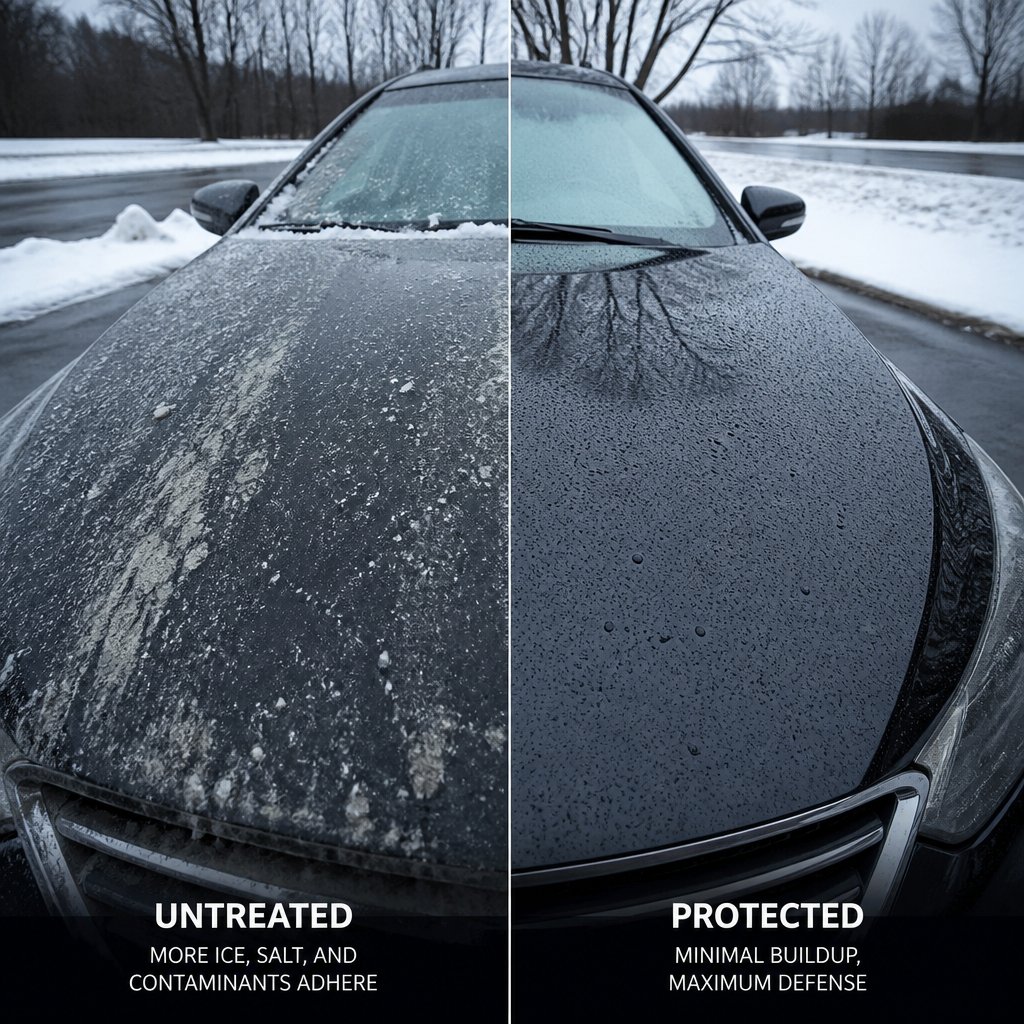
Glendale Heights and the broader DuPage County area experience winters that are genuinely hostile to automotive paint. Road salt brine is applied aggressively across the Chicago suburbs from late November through early March. Freeze-thaw cycling means that salt solution works its way into every surface irregularity repeatedly. UV exposure during Chicago summers adds oxidation stress. And pollen season in spring deposits a fine, chemically active film across every parked vehicle in Carol Stream, Bloomingdale, Wheaton, and the surrounding communities.
This climate context matters because it is the actual test environment for any paint protection you invest in. A self-cleaning ceramic coating in the Chicago area needs to handle more than a perfect sunny day on a closed course. It needs to handle a February morning when the car is coated in salt spray and the temperature swings from 10 degrees to 38 degrees between night and afternoon.
Why Wax Fails in Illinois Winters
Traditional carnauba wax, regardless of quality, is chemically incompatible with extended Illinois winters. The alkalinity of road salt solution, combined with the thermal cycling, breaks down wax's protective matrix within weeks of application during peak winter. Wax does not bond to paint at the molecular level, so once the thin protective film is compromised, bare clear coat is exposed to everything the road throws at it. Using wax as your primary paint protection strategy in this climate is a losing proposition.
How Professional Ceramic Coatings Handle Road Salt
A professionally applied nano-ceramic coating chemically bonds to the clear coat and cures to a hardened glass-like layer. This layer is chemically resistant to the alkaline pH of road salt and brine solutions. Water beads off the surface rather than pooling and sitting in contact with the paint through repeated freeze-thaw cycles. The result is that road salt has far less opportunity to etch, stain, or contaminate the paint surface over the course of a Chicago winter. Vehicles that arrive at the spring detail season with a professional ceramic coating in good condition require dramatically less corrective work than those that relied on wax or no protection at all.
Pro tip: In the Chicago suburbs, the ideal time to apply a professional ceramic coating is late September through October. The coating has time to fully cure before winter road salt season begins, and your paint goes into the harshest months of the year with full hydrophobic protection already established.
Comparison of Hydrophobic Protection Options
Not all hydrophobic paint protection products are built the same. The differences between a consumer spray sealant, a paint sealant from a dealership, and a professionally applied nano-ceramic coating are substantial enough that treating them as interchangeable is a serious mistake for any luxury or high-end vehicle owner.
| Protection Type | Hydrophobic Performance and Durability | Best For and Key Limitations |
|---|---|---|
| Consumer SiO2 Spray Sealant (retail products, auto parts store) | Moderate water beading; contact angle typically lower than professional ceramic; protection lasts 6 to 12 months under normal conditions, often less than 6 months in heavy road salt environments | Suitable for budget-conscious maintenance between professional services; not appropriate as sole protection for high-end vehicles or Illinois winters; does not chemically bond to paint |
| Dealership Paint Sealant (often sold at point of purchase) | Similar to consumer spray in many cases; rarely disclosed which specific product is used; may be applied to uncorrected paint from transport; durability claims often overstated | Convenient at purchase but frequently overpriced for what is delivered; applied without paint correction in most cases, meaning defects are sealed in; no meaningful warranty from a qualified detailing professional |
| Professional Nano-Ceramic SiO2 Coating (multi-layer, professionally applied with full prep) | Tight, fast-rolling water beads; high contact angle; chemical bond to clear coat; surface hardness up to 9H; designed to last 5 to 8 years with proper maintenance in real-world driving conditions including Illinois winters | Requires full decontamination and paint correction before application; higher upfront investment; must be applied in a controlled environment; the correct choice for luxury vehicles, daily drivers in harsh climates, and anyone serious about long-term paint condition |
Pro tip: If a detailer applies a ceramic coating without first performing at least a single-stage paint correction and a decontamination wash including clay bar or iron fallout removal, the coating is bonding to contaminated or defect-laden paint. Ask specifically what the prep process includes before any coating service. The prep work is where the quality difference between detailers is most clearly visible.
What Professional Application Actually Changes
The product in a bottle is only part of what you are paying for when you choose a professional ceramic coating service. The application environment, the surface preparation, and the experience of the technician applying the coating determine whether a 5-year or 8-year coating actually performs for its warranted life.
Surface Preparation: The Non-Negotiable Foundation
A ceramic coating bonds to whatever surface it contacts. If that surface has iron fallout from brake dust embedded in the clear coat, or swirl marks from years of automatic car washes, or oxidation from sun exposure, the coating locks all of that in permanently. This is why the decontamination process, which includes a proper chemical decontamination wash, iron fallout treatment, and often clay bar treatment, is not an upsell. It is the process that determines what your paint looks like under the coating for the next several years.
Multi-stage machine polishing before ceramic coating application corrects paint defects that cannot be addressed any other way. A two-stage correction process removes both deeper scratches and the fine swirl marks left by single-stage polishing, leaving a surface that is genuinely flawless before the coating goes on. Skipping this step and applying a coating directly over defects is exactly what corners-cut detailing looks like, and it shows the moment light hits the panel at the right angle.
Application Environment and Curing
Professional ceramic coatings cannot be applied correctly outdoors, in direct sunlight, in high humidity, or in dusty environments. The coating needs to be wiped onto the panel in controlled sections, leveled before it flashes, and allowed to cure without contamination. Dust particles landing on a coating during cure create high spots that must be polished out, and doing so can compromise the coating's bond in those areas. A detailing studio with climate control, proper lighting, and a dust-controlled bay is not a luxury for ceramic coating work, it is a requirement.
After application, the curing period typically runs 24 to 48 hours for light exposure and up to a full week for the coating to reach its full hardness. During this window, the vehicle should not be exposed to rain, bird droppings, washing, or surface contact. Rushing this step by driving the vehicle into the rain before full cure is a common cause of early coating failure that gets blamed on the product rather than the process.
Maintenance After Coating: What Self-Cleaning Actually Requires from You
A professionally coated vehicle is not a set-and-forget investment. The hydrophobic properties remain strong when the coating surface is kept clean of the silica-based contaminants that can slowly degrade its chemical structure. Bird droppings are the most dangerous, their uric acid content can chemically etch a ceramic coating if left for more than a day or two, particularly in warm weather. Bug splatter has a similar effect. The coating makes removal of these contaminants dramatically easier than it would be on bare paint, but it does not make the contaminants harmless if left indefinitely.
A proper maintenance routine for a coated vehicle in the Chicago suburbs includes pH-neutral hand washing, avoidance of automated car washes with harsh brushes, and periodic application of a ceramic coating maintenance booster to reinforce the hydrophobic top layer. Annual inspection by the detailer who applied the coating allows any wear areas to be identified and addressed before they compromise the underlying paint.
Frequently Asked Questions
Does a hydrophobic ceramic coating mean I never have to wash my car?
No. A hydrophobic coating significantly reduces how much contamination bonds to your paint and makes washing far easier, but it does not eliminate the need for regular washing. Bird droppings, bug splatter, tree sap, and industrial fallout still accumulate and can damage the coating if left unaddressed. The realistic expectation is that your car stays cleaner between washes and that washing takes less effort, not that washing is unnecessary.
What is the difference between a SiO2 spray sealant I can buy at a store and a professional SiO2 ceramic coating?
The chemistry involves the same base compound, silicon dioxide, but the concentration, cross-link density, and application method are entirely different. Consumer spray sealants create a thin film that lasts months. Professional ceramic coatings applied by a trained detailer form a covalent chemical bond with the clear coat, cure to a hardened layer, and are engineered to last years. The professional version also requires full paint decontamination and correction before application, which is what makes the surface the coating bonds to worthy of a multi-year investment.
Why does my ceramic-coated car still get water spots?
Water spots form when water beads sit on a surface long enough to evaporate, leaving their dissolved mineral content behind. A ceramic coating reduces the likelihood of this by making beads roll off quickly at low angles, but in direct sun with hard water, spots can still form if water is left sitting on the panel. The coating makes these spots easier to remove than they would be on bare paint, but proper rinsing, drying after a wash, and keeping the car out of sprinklers helps prevent them from forming in the first place.
How long does a professional ceramic coating actually last on a car driven through Chicago winters?
A professionally applied multi-layer SiO2 ceramic coating, applied over properly decontaminated and corrected paint, is designed to last significantly longer than consumer alternatives in real-world conditions including road salt and freeze-thaw cycles. The specific warranty period depends on the product system used and the detailer's application process. At Hersheys Detailing, the ceramic coating packages include 5-year and 8-year warranty options, applied with full two-step paint correction included, which means the coating is bonding to properly prepared paint rather than a defect-laden surface.
Is water beading or water sheeting a better sign that a ceramic coating is working correctly?
Neither behavior alone tells the full story. Tight water beads that roll off quickly at a low surface angle are a positive indicator of active hydrophobic protection. Water that merges into sheets and drains off the panel in one mass is also a positive indicator and in some ways reduces water spot risk. The real question is whether either behavior is still present months and years after application, and whether the surface stays clean between washes. Marketing photos of dramatic beads taken immediately after application tell you very little about long-term performance.
Does a ceramic coating protect against paint chips and rock damage?
A ceramic coating provides genuine protection against fine scratches, swirl marks, and surface abrasion due to its surface hardness. It does not protect against the impact of gravel, road debris, or stone chips at highway speed. That protection requires paint protection film. For vehicle owners in the Chicago area who frequently travel on expressways or highway construction zones, combining a ceramic coating with PPF on the front bumper, hood, and mirror caps is the most complete approach to paint protection.
Can I apply a ceramic coating myself and get the same result as a professional?
Consumer-grade DIY ceramic coating kits exist, and they can add some hydrophobic protection. However, without the paint correction and decontamination steps that professional application requires, you are sealing whatever surface condition your paint is already in. Without a climate-controlled application environment, contamination during the curing process is a real risk. And without experience in identifying and leveling the coating before it flashes, high spots and streaks are common failures. For a daily driver where some protection is better than none, a DIY kit is an option. For a luxury vehicle where you expect the coating to look and perform correctly for years, professional application is the only reasonable choice.
Have you had a ceramic coating applied in the Chicago suburbs, and did the results match what you expected from the hydrophobic and self-cleaning claims? Share your experience below.
References
- Detailed Image: Water Beading vs. Water Sheeting and What Paint Protection Really Looks Like
- Dr. Beasley's Guide to Water Beading and Sheeting on Ceramic Coated Surfaces
- Chemical Guys: How Long Ceramic Coating Lasts and What Affects Durability
- How Long Ceramic Coating Lasts in the Chicago Climate: Road Salt, UV, and Winter Grime
- Professional vs. Consumer Ceramic Coating Performance in Harsh Winter Environments