If you own a luxury vehicle in the Chicago suburbs and you're not actively protecting your paint, Illinois is working against you every single month of the year. Illinois winter car paint damage gets most of the attention, and for good reason, but the threat doesn't stop when the snow melts. From the road salt that coats every surface of your car between November and March, to the intense UV radiation that fades paint through the summer, to the acidic pollen and acid rain of spring, this state cycles through four distinct paint-killing seasons. Vehicles in Glendale Heights, Carol Stream, Bloomingdale, and Wheaton take the full force of all of them. Here is exactly what each season does, and how to stop it.
Table of Contents
- What Winter Road Salt Actually Does to Your Paint
- The Freeze-Thaw Cycle: Winter's Other Paint Killer
- Spring: Pollen, Acid Rain, and the Season of False Relief
- Illinois Summer UV Damage and Paint Oxidation
- Fall: The Setup Season Most Owners Ignore
- Protection Comparison: Wax vs. Sealant vs. Ceramic Coating
- How to Actually Protect Your Paint Year-Round in the Chicago Suburbs
- Frequently Asked Questions
- References
What Winter Road Salt Actually Does to Your Paint
Road salt damage in Chicago is not just about rust on the undercarriage. The process that attacks your paint is more insidious than most owners realize, and it happens faster than you expect.
Road salt does not rust paint directly, because paint is not metal. What it does instead is work its way into the microscopic pores of your clearcoat. Road salt can corrode a car's paint by allowing salt ions to settle into the tiny pores in a coat of paint. Over time, those ions create a mild acid that attacks the clearcoat surface. Once the clearcoat is compromised, moisture reaches the paint layer underneath, and eventually the bare metal.
Salty slush ends up on your car's paint in several ways: passing cars spray it onto the sides of your vehicle, large trucks can kick up enough slush to land on your hood and even the roof of your car, and your own tires splash salt on side panels and wheel wells. In the Chicago suburbs, every commute on a salted road is a fresh application.
How Fast Does Salt Damage Start?
Salt can begin causing corrosion within days when moisture is present. The speed of corrosion depends heavily on the environment, and in dry conditions, salt is relatively harmless. However, winter weather often brings humidity, melting snow, and slush, which activates the corrosive properties of salt.
The situation gets worse when you pull into a heated garage. If you drive on salted roads and park in a garage where the snow melts, the resulting saltwater sits on your car's components, accelerating the rusting process. A warm garage feels like a kindness to your vehicle, but it is actually the environment where salt does its most efficient work.
Some of the most damaging salt buildup happens in places you rarely see. Rocker panels, door seams, and clogged drainage channels can trap moisture for weeks. When salty water sits in these tight spaces, it slowly spreads rust beneath coatings and into structural areas.
Pro tip: After every significant snowfall or road salt exposure, wash your car within 48 hours. Pay specific attention to the undercarriage, wheel wells, and rocker panels. A standard touchless wash is not enough. You need dedicated undercarriage rinse pressure to dislodge packed slush from seams.

The Freeze-Thaw Cycle: Winter's Other Paint Killer
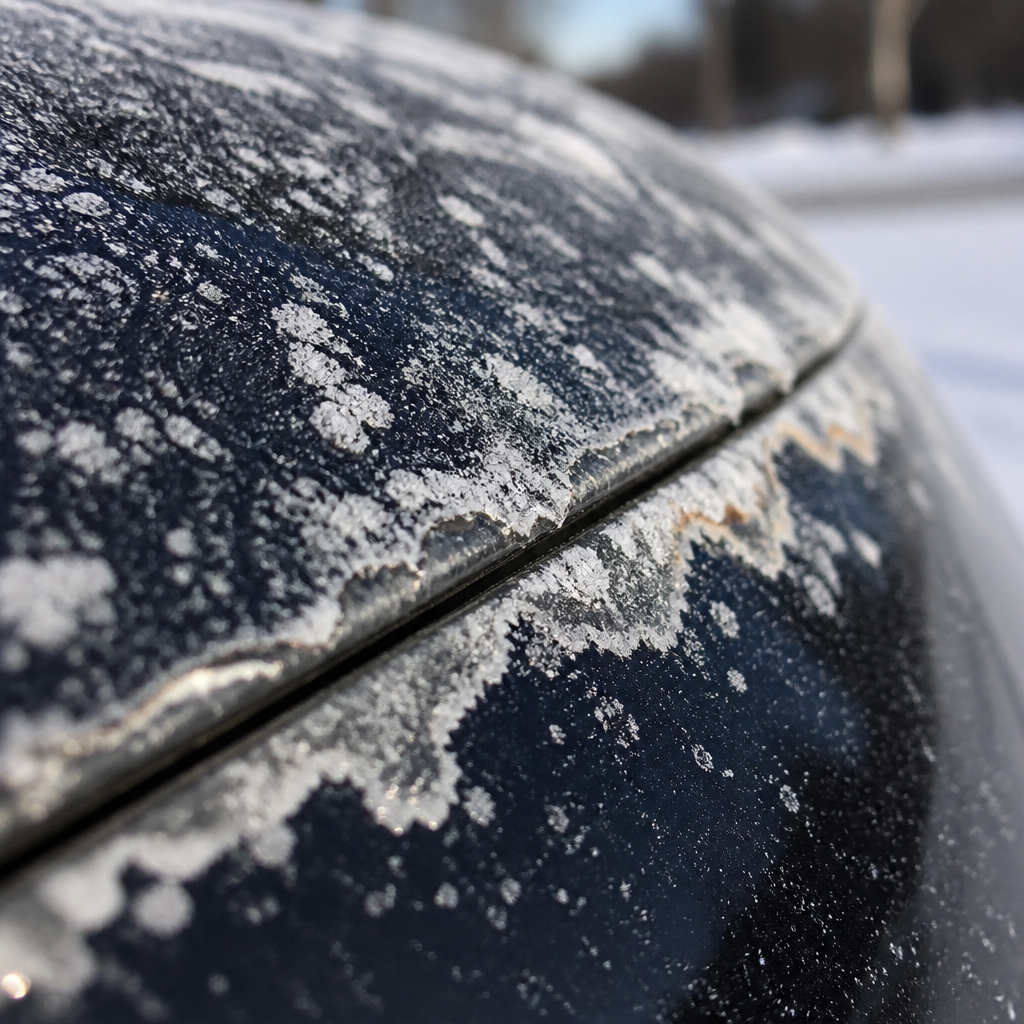
Beyond the chemistry of salt ions, there is a second destructive force at work every Chicago winter: the physical stress of freezing and thawing. This is the part of Illinois winter car paint damage that does not show up until spring, which is why so many owners are blindsided by it.
When moisture enters a small chip or scratch in your paint and then freezes, it expands. When it thaws the next day, it contracts. This cycle repeats dozens of times across a single Chicago winter, widening micro-damage with each pass. By March, what was an invisible scratch in October has become a visible edge where the clearcoat has lifted and rust has started to form beneath the surface.
The lesson here is that any pre-existing paint damage, even a tiny stone chip from summer highway driving, becomes a significant liability before winter arrives. A chip that costs very little to address in September becomes a rust repair job by February. Pre-winter paint inspections and touch-ups are not optional maintenance for Chicago-area vehicle owners. They are damage prevention.
Pro tip: Have your paint professionally inspected before the first frost. Any chip that has already reached bare metal needs to be addressed before the freeze-thaw cycle turns it into a much larger and more expensive problem.
Spring: Pollen, Acid Rain, and the Season of False Relief
When the salt finally stops flying in April, many vehicle owners relax. That is a mistake. Spring in Illinois introduces a different category of paint threat, one that is chemical rather than physical.
How Pollen Etches Clearcoat
Pollen contains natural compounds that, when exposed to moisture, release mild organic acids. In the presence of morning dew, rain, humidity, or ambient condensation from temperature swings, these acids begin a slow etching process on automotive clearcoat. In the Chicago suburbs, spring mornings are often humid and dew-heavy, which means pollen that lands on your car overnight is actively reacting with your paint surface by the time you step out to your driveway.
Clearcoat is a polymer, and polymers degrade when exposed to acidic conditions over time. The result is etched spots, discoloration, and weakened protection for the color layer beneath.
The Pollen Dwell-Time Problem
A vehicle washed weekly during peak pollen season experiences roughly seven days of maximum pollen exposure per cycle. A vehicle washed once a month experiences thirty. Over multiple spring seasons, that difference adds up to visible paint degradation. For owners in Carol Stream and Bloomingdale, where trees line most residential streets, pollen accumulation in April and May is not a minor inconvenience. It is a real paint threat.
Acid rain compounds the problem. Acid rain results from pollutants in the air that combine with moisture, creating an acidic solution that can etch and damage your car's paintwork. The Chicago area's industrial and urban air quality makes acid rain a routine occurrence during spring storm cycles, not a rare event.
The Spring Decontamination Your Paint Actually Needs
A standard car wash after winter is not a spring detail. A proper spring process requires a full decontamination, meaning a clay bar or chemical decon treatment to pull embedded iron particles, brake dust, and salt residue from the paint surface before applying any protection. Skipping this step and applying wax or sealant over contaminated paint traps the contaminants underneath the protection layer, where they continue to work.
Illinois Summer UV Damage and Paint Oxidation
Illinois summers deliver sustained heat and intense UV radiation. For vehicles that spend their days parked in open lots, this is the season that causes UV paint fade in Illinois, and the damage compounds every year it goes unaddressed.
How UV Rays Break Down Paint
Ceramic coatings contain UV-resistant compounds that help reduce the penetration of harmful radiation, providing effective UV protection for car paint. The reason this matters is that without protection, UV rays initiate a process called oxidation: paint reacts with oxygen under UV exposure, and the result is color that becomes chalky, dull, and faded. Dark-colored vehicles, especially black, navy, and dark charcoal, show this degradation fastest.
By forming a barrier between paint and environmental elements, a quality coating slows oxidation significantly. Many car owners ask whether ceramic coating prevents fading. It significantly delays colour degradation. Without a UV barrier of some kind, a vehicle parked outdoors in a Chicago suburb for several summers will develop visible fading, particularly on horizontal surfaces like the hood and roof that receive the most direct sun exposure.
Heat also activates any contaminants already on the paint. Tree sap, bird droppings, and insect residue that might wash off easily in cooler conditions can bond permanently to warm paint surfaces in summer temperatures. Leaving any of these on your paint in July or August is a reliable way to create an etch mark that requires machine polishing to remove.
Fall: The Setup Season Most Owners Ignore
Fall in the Chicago suburbs is the most underestimated threat on this list, not because it is the most destructive, but because it determines how much damage winter will do.
Falling leaves carry tannins that stain and etch paint when they sit wet on a surface. Morning dew in October and November keeps leaves moist and in contact with your paint for hours at a time. Tree sap continues to drop through October. And if you have not decontaminated and protected your paint before the first road salt application of the season, the salt will have direct access to whatever oxidation or micro-damage has accumulated through summer and fall.
The Pre-Winter Protection Window
The window between late September and the first hard freeze is the single most important time of year to invest in your paint. This is when a professional decontamination, paint correction, and ceramic coating application makes the greatest difference. The coating bonds to clean, corrected paint, not to a surface still carrying summer contamination. If you miss this window, you are sending your vehicle into an Illinois winter unprotected.
Applying protection to paint that hasn't been properly decontaminated and corrected is like putting a screen door on a submarine. The barrier is there, but it doesn't actually stop anything.
At Hersheys Detailing in Glendale Heights, every ceramic coating package includes a full two-step paint correction before the coating is applied. That step is not upselling, it is the reason the coating performs correctly. A coating applied over scratches, swirls, and embedded contamination locks that damage in permanently under a hard layer. There is no recovering from that without removing the coating entirely.
Protection Comparison: Wax vs. Sealant vs. Ceramic Coating
Not all paint protection handles the seasonal conditions of the Chicago suburbs equally. Here is how the three main options compare against Illinois-specific threats.
| Protection Type | What It Does Well | Where It Falls Short in Illinois |
|---|---|---|
| Carnauba Wax | Provides a warm gloss finish, easy to apply, short-term hydrophobic barrier against pollen and light contaminants | Lasts 4-8 weeks in real-world conditions. Offers minimal UV protection. Road salt and repeated washing strip it quickly. Needs reapplication every month through an Illinois winter to remain effective. |
| Synthetic Sealant | Lasts 3-6 months, better UV resistance than wax, more durable against salt and washing than carnauba | Still requires seasonal reapplication. Does not chemically bond with paint. Provides moderate protection but is not adequate for vehicles exposed to full Chicago winters year after year without additional upkeep. |
| Professional Ceramic Coating (SiO₂) | Chemically bonds to clearcoat at the molecular level. Provides durable UV resistance, hydrophobic protection, and a barrier against salt ions, pollen acids, and road grime. Hersheys Detailing offers 5-year and 8-year warranty packages. | Requires professional application on a properly corrected surface. Not a DIY product if long-term performance is the goal. Upfront investment higher than wax or sealant, but total cost of protection over 5-8 years is significantly lower. |
Among the various options, ceramic coatings stand out as the most durable protector for a vehicle's paint against sun and weather damage. Unlike traditional waxes or sealants, ceramic coatings chemically bond with your paint, creating a lasting barrier that maintains your vehicle's vibrant color and showroom shine.
For owners of luxury and high-end vehicles in the Chicago suburbs, the math is straightforward. Multiple wax applications per year, plus the labor cost of regular professional waxing, plus the eventual cost of paint correction to address the damage that wax failed to prevent, adds up to more money than a single professional ceramic coating applied correctly and maintained properly.
How to Actually Protect Your Paint Year-Round in the Chicago Suburbs
Understanding the threats is useful. Acting on them in the right sequence is what actually protects your paint.
The Annual Protection Calendar for Illinois
Late September through early November is your pre-winter window. This is when professional paint correction and ceramic coating application should happen. The paint is at its most accessible before winter grime sets in, and the coating needs stable temperatures to cure properly.
November through March is active defense. Wash your vehicle every one to two weeks during heavy road salt season, focusing on the undercarriage. Frequent car washes during winter are essential. Aim to wash your vehicle weekly to prevent salt from sticking to the paint and causing rust. A vehicle with a properly installed ceramic coating sheds road salt and slush much more efficiently, meaning each wash is more effective and the intervals between damage can be longer.
April through May is spring decontamination time. A full iron decontamination, clay bar treatment, and inspection for any winter damage should happen before spring pollen season peaks. Address any chips that made it through winter before they grow.
June through August, maintain hydrophobic protection. If you are relying on wax or sealant, reapply it. If you have a ceramic coating, a proper maintenance wash with a pH-neutral shampoo is all you need to maintain the coating's performance through summer.
What Ceramic Coating Maintenance Actually Looks Like
A common misconception about ceramic coatings is that they are maintenance-free. They are not. What they eliminate is the need for repeated protective product applications. The maintenance you do need is regular washing with products that are pH-neutral and do not strip the coating. Avoid automatic car washes with abrasive brushes, which create swirl marks that degrade the coating's reflective quality over time. Hand washing, or touchless washes only, is the correct approach.
Pro tip: At Hersheys Detailing, ceramic coating clients receive guidance on the correct maintenance wash routine for their specific coating package. Following that routine is what allows a 5-year or 8-year warranty to actually deliver on its promise. Ignoring it will not void protection immediately, but it will reduce the coating's hydrophobic performance noticeably within one or two years.
Paint Correction Before Coating: Why It Is Not Optional
A ceramic coating is a transparent, hard layer that bonds directly to the surface beneath it. Whatever condition that surface is in when the coating goes on is the condition it will be in, locked under the coating, for the life of the product. Swirl marks from prior automatic car washes, light scratches, water spot etching, and oxidation do not disappear under a coating. They get preserved. This is why a multi-stage machine polishing process before coating application is not a luxury step. It is the difference between a flawless finish that holds its appearance for years and a glossy surface that amplifies every defect underneath it.
Frequently Asked Questions
How long does road salt take to damage car paint in Illinois?
Salt can begin causing corrosion within days when moisture is present. In Illinois winters, moisture is almost always present in the form of snow melt, slush, and humidity. A vehicle that goes several weeks without washing during active road salt season will show measurable clearcoat degradation, especially around chips, lower door panels, and rocker panels.
Is car wax enough to protect against Chicago winter road salt?
Wax provides a short-term barrier, but it is not adequate as a sole defense against Illinois winter conditions. Carnauba wax degrades quickly under repeated exposure to road salt and the alkaline residue left by many car wash soaps. A fresh wax coat every four to six weeks through winter can reduce some damage, but most owners will not maintain that schedule. A synthetic sealant or professional ceramic coating provides significantly more durable and reliable protection.
What causes UV paint fade in Illinois summers, and can it be reversed?
UV radiation breaks down the clearcoat through oxidation, causing paint to appear chalky, dull, and faded, particularly on horizontal surfaces. Once oxidation has progressed into the color layer itself, the only way to restore color depth is through machine polishing to remove the degraded clearcoat. Light surface oxidation can often be corrected. Deep color fade that has reached the base coat layer is a much more significant repair. Preventing UV fade with a ceramic coating or at minimum a quality sealant is far less expensive than correcting it after the fact.
When is the best time of year to get a ceramic coating applied in the Chicago suburbs?
The fall window, roughly late September through early November, is the optimal time for ceramic coating application in the Chicago area. Temperatures are stable enough for the coating to cure properly, and you capture the full benefit of protection before the road salt season begins. Spring is a viable second option after a thorough post-winter decontamination and correction. Avoid application in extreme heat or cold, and never apply a ceramic coating outdoors in humid conditions.
Do ceramic coatings actually protect against road salt, or is that just marketing?
Professional SiO₂ ceramic coatings do provide genuine protection against road salt by creating a hydrophobic, chemically resistant barrier that prevents salt ions from reaching the pores of your clearcoat. The key words are "professional application" and "on a properly prepared surface." A ceramic coating applied correctly to corrected paint performs exactly as described. A spray-on consumer coating applied over contaminated paint does not. The chemistry is real. The results depend entirely on proper preparation and application.
What damage does spring pollen actually do to car paint in Illinois?
Pollen contains natural compounds that, when exposed to moisture, release mild organic acids that begin a slow etching process on automotive clearcoat. Clearcoat is a polymer, and polymers degrade when exposed to acidic conditions over time, resulting in etched spots, discoloration, and weakened protection for the color layer beneath. In practice, a vehicle left unwashed through a heavy pollen week in Illinois will often develop light etching that requires machine polishing to fully remove. Weekly washing during April and May is not excessive, it is the minimum needed to prevent accumulating damage.
We'd love to hear from local vehicle owners: which season has caused the most visible damage to your car's paint, and what has worked best for you to fight it?
References
- Chicago winter car care and how road salt damages vehicle paint and clearcoat
- How road salt creates corrosive brine that attacks paint, clearcoat, and metal components
- How road salt accumulates in hidden areas and causes damage to vehicle exteriors
- Why ceramic coatings outperform wax and sealant for UV and weather protection
- Top springtime environmental pollutants that damage car paint including pollen and acid rain