Most vehicle owners in the Chicago suburbs wash their cars regularly and assume that counts as proper care. It does not. Every time you drive down North Avenue, circle the Bloomingdale Road corridor, or park near any rail line, your paint is collecting microscopic iron particles from brake dust, industrial fallout, and rail dust that no amount of soap and water will ever remove. This is exactly why paint decontamination in Glendale Heights, IL is the single most skipped and most consequential step in professional auto detailing. Skip it, and every wax, sealant, or ceramic coating you apply is bonding to contaminated paint, not clean paint. The results will always be inferior, and in many cases, the damage compounds invisibly until it becomes permanent.
Table of Contents
- What Paint Decontamination Actually Is
- Why Washing Is Not Enough
- Iron Fallout in the Chicago Suburbs
- The Two-Stage Decontamination Process Explained
- Why Decontamination Before a Ceramic Coating Is Non-Negotiable
- Decontamination Method Comparison
- Signs Your Car Needs Decontamination Right Now
- Frequently Asked Questions
- References
What Paint Decontamination Actually Is
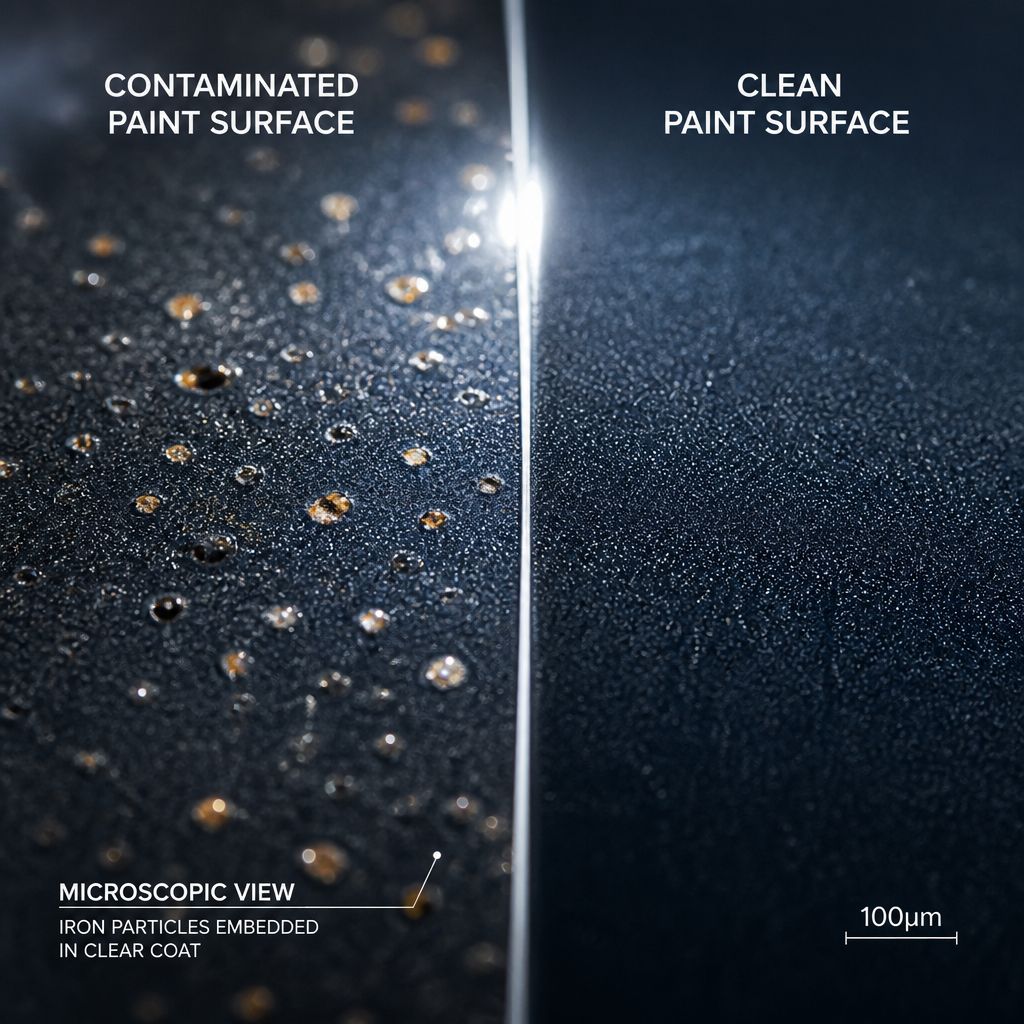
Paint decontamination is the process of removing bonded contaminants from a vehicle's clear coat that cannot be dislodged by washing alone. These contaminants fall into two main categories: ferrous (iron-based) particles like brake dust and rail dust, and non-ferrous particles like tree sap, tar, and industrial overspray. A standard car wash removes loose surface dirt. Decontamination removes the material that has physically embedded itself into or bonded onto the clear coat surface.
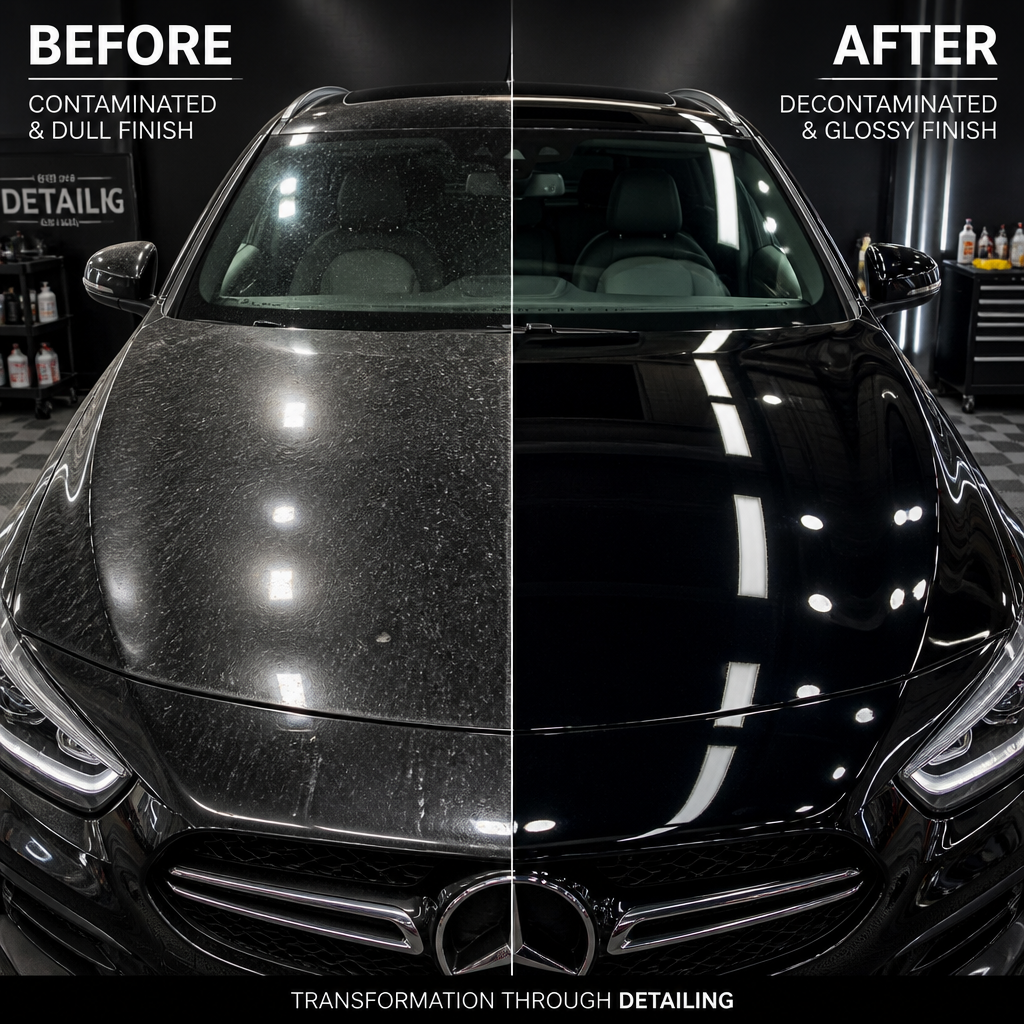
The distinction matters because bonded contamination is invisible to the naked eye in most cases. A car can look clean from ten feet away and feel like fine sandpaper under a gloved hand. That texture is contamination that has been accumulating with every mile driven. The longer it sits, the more it oxidizes and the harder it becomes to remove without damaging the clear coat underneath.
Decontamination is not a luxury add-on. It is the mandatory foundation for any paint correction, wax application, or ceramic coating. Applying a protective layer over contaminated paint traps the contamination in place and undermines both the adhesion and the longevity of whatever product goes on top.
Why Washing Is Not Enough
A two-bucket wash removes road grime, bird droppings, and loose surface dust. It does a poor job and often zero job on anything that has bonded to the clear coat. Iron particles from brake dust do not sit on the surface. They penetrate the clear coat and oxidize into the paint structure itself, creating micro-rust points that spread over time.
The confusion comes from the fact that freshly washed paint can look excellent. Gloss is restored, color pops, and the car feels clean. But run your hand in a plastic bag over the hood of a vehicle that has never been decontaminated, and you will feel a roughness that should not be there. That texture is the contamination a wash left behind. Professional detailers call this the baggie test, and it is one of the most reliable ways to reveal what washing cannot fix.
A vehicle can look flawless from ten feet away and feel like sandpaper under a plastic bag test. The paint is loaded with iron fallout and tar that no amount of washing has touched. That gap between appearance and actual surface condition is where long-term paint damage begins.
A common mistake among vehicle owners who detail at home is relying on a quick spray wax or paint sealant to compensate for a rough surface. Sealants do not bond correctly to contaminated clear coat. They create an uneven layer that degrades faster, looks duller, and offers significantly less protection than the same product applied over properly decontaminated paint.
Pro tip: Before any wax, sealant, or coating application, put your hand in a sandwich bag and glide it over the freshly washed paint. If it feels anything other than glass-smooth, the surface needs chemical and mechanical decontamination before you proceed.
Iron Fallout in the Chicago Suburbs
Vehicles in the Chicago suburbs face an unusually heavy contamination load compared to cars in less industrialized or less transit-heavy regions. The density of rail lines throughout DuPage County, combined with the high volume of truck and commercial traffic on roads like Roosevelt Road, Route 53, and the I-290 corridor, means brake dust contamination accumulates faster than in quieter suburban environments.
Rail dust is particularly aggressive. Trains shed iron particles from the friction between brake pads and wheels at a far higher rate than passenger vehicles, and those particles travel considerable distances in the air before settling on paint. Vehicles parked near Metra lines or rail crossings in Carol Stream, Wheaton, and Bloomingdale are exposed to this consistently. The particles are microscopic, which means they are invisible, and because they land on a clean-looking surface, most owners never suspect they are there.
Industrial fallout from manufacturing facilities, construction zones, and even airport-adjacent areas in the broader Chicago metro compounds this exposure. The result is that vehicles in this region typically carry far more embedded iron contamination than their owners realize, and professional iron fallout removal in the Chicago suburbs is not a periodic luxury. For most daily drivers here, it is a maintenance necessity.
Pro tip: If you park near a Metra rail line or commute on I-290 or the I-88 corridor regularly, plan for a full chemical decontamination at least twice a year, regardless of how clean your paint looks after washing.
The Two-Stage Decontamination Process Explained
Professional decontamination is a two-stage process, and the order of operations is not flexible. Chemical decontamination comes first. Mechanical decontamination comes second. Reversing this order, or skipping either stage, leaves contamination on the paint and risks unnecessary abrasion of the clear coat.
Stage One: Chemical Decontamination
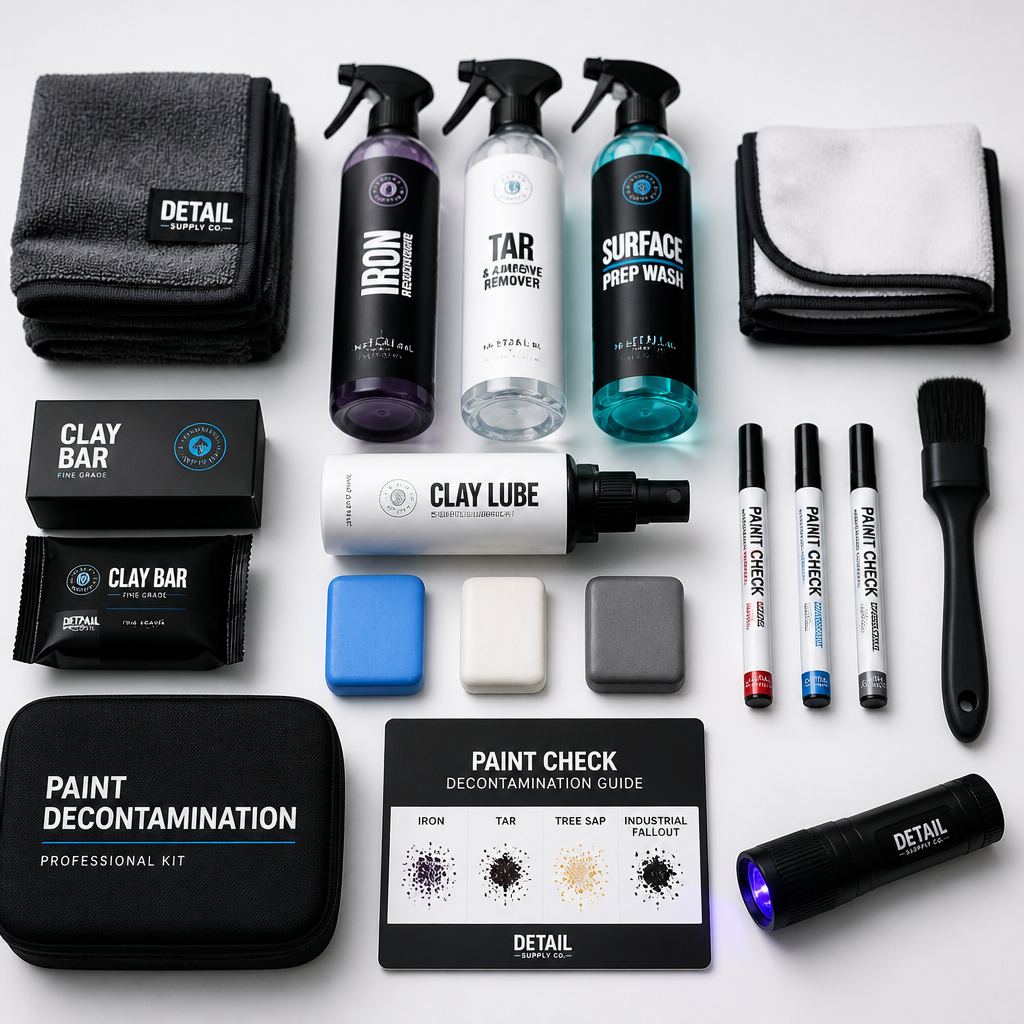
The first stage uses two types of chemical products applied sequentially. An iron remover, typically containing an iron-reactive compound, is sprayed across the paint surface and allowed to dwell. The chemistry reacts with ferrous metal particles embedded in the clear coat, converting them into a water-soluble compound. The visual indicator is a color change, usually purple or red, wherever the product contacts iron. Each streak of color represents a brake dust particle or piece of industrial fallout being chemically dissolved off the paint. The product is then rinsed thoroughly before it can dry.
A dedicated tar and adhesive remover follows next, targeting non-ferrous bonded contaminants. Tar, road pitch, tree sap residue, and paint overspray are not affected by iron removers. The tar remover dissolves these by different chemistry, typically solvent-based formulas that break down hydrocarbon-based deposits without damaging the clear coat when used correctly.
Stage Two: Clay Bar Decontamination in Illinois
Clay bar decontamination in Illinois is the mechanical stage. After chemical decontamination has dissolved what it can, a clay bar or synthetic clay towel is worked across the paint surface with a lubricant to physically lift and trap any remaining bonded particles that chemistry alone did not fully address. The clay does not distinguish between types of contamination. It mechanically grips anything protruding from the clear coat surface and pulls it away.
What most people do not know is that clay bar without prior iron removal is significantly less effective and more abrasive. Iron particles that have not been chemically softened are harder, and dragging a clay bar across them increases the risk of micro-marring the clear coat. Doing the chemical stage first makes the clay bar stage safer and more thorough. This is why professional detailers treat them as a system, not as alternatives to each other.
Why Decontamination Before a Ceramic Coating Is Non-Negotiable
Ceramic coatings bond directly to the clear coat surface. The quality of that bond depends entirely on how clean and how chemically bare that surface is when the coating is applied. Any iron particle, tar deposit, or bonded contamination sitting on the paint at the time of application will be sealed under the ceramic layer.
The consequences are not just cosmetic. Contamination sealed under a ceramic coating continues to oxidize. Iron particles continue to expand as they rust, creating micro-lifting of the coating from below. The result is premature coating failure, poor hydrophobic performance, and in severe cases, paint staining that requires full correction to fix. A coating that should last five to eight years can fail in a fraction of that time if it was applied over paint that was not properly decontaminated first.
At Hersheys Detailing, the decontamination stage is built into the prep process for every ceramic coating service. The nano-ceramic SiO₂ coatings applied carry 5 to 8-year warranties, and those warranties are only meaningful if the prep work underneath them is done properly. Applying a premium ceramic product to contaminated paint would be the equivalent of painting over rust. The product looks right initially and degrades in ways that could have been prevented entirely.
This is also why decontamination is required before multi-stage machine polishing and paint correction. Polishing compounds work by abrading the clear coat to remove defects and level the surface. If iron particles are still embedded in the paint when a machine polisher passes over it, those particles act as additional abrasives, creating new scratches while the detailer is trying to remove existing ones. Decontamination first means the polishing stage is working only on the clear coat surface as intended.
Decontamination Method Comparison
Understanding how each decontamination method works and what it targets helps clarify why professional shops use all three in sequence rather than picking one and calling it complete.
| Method | What It Removes | What It Cannot Remove |
|---|---|---|
| Iron Remover (Chemical) | Brake dust, rail dust, embedded ferrous metal particles, industrial iron fallout | Tar, tree sap, paint overspray, non-ferrous contamination |
| Tar and Adhesive Remover (Chemical) | Road tar, pitch, tree sap residue, adhesive deposits, paint overspray | Iron particles, ferrous fallout, bonded mineral contamination |
| Clay Bar (Mechanical) | Any remaining bonded surface contamination regardless of type | Scratches, swirl marks, oxidation, anything below the paint surface |
In practice, a professional decontamination service runs all three in this exact sequence. Chemical iron treatment first, tar removal second, clay bar last. Each stage addresses what the previous stage left behind, and the combined result is a surface that is genuinely clean at a molecular level, not just visually clean from a distance.
Signs Your Car Needs Decontamination Right Now
Paint contamination is not always visible. That is part of what makes it so frequently overlooked. However, there are reliable indicators that signal your vehicle's paint has accumulated enough contamination to require professional attention.
The Surface Feels Rough After Washing
If you run a clean microfiber cloth or a bagged hand over freshly washed paint and it does not feel glass-smooth, you are feeling bonded contamination. A clean, decontaminated surface should feel completely slick. Roughness or a gritty texture that persists after washing is one of the clearest signs that a full decontamination is overdue.
Orange or Brown Specks on Light-Colored Paint
Iron particles oxidize into rust as they sit in the clear coat. On white, silver, or light gray paint, this shows up as small orange or brown dots that do not wash away. These are not defects in the paint itself. They are iron fallout that has rusted in place. On dark-colored vehicles, this same process occurs but is invisible to the eye, which is why dark cars should be decontaminated on a scheduled basis regardless of whether specks are visible.
Wax or Sealant Not Lasting as Long as It Should
If a wax or sealant is fading significantly faster than its listed durability would suggest, contaminated paint is a likely cause. Products bond to clean clear coat. They do not bond well to a surface covered in iron particles and tar. The protection layer degrades faster because it never had a proper foundation to begin with.
You Are Preparing for a Ceramic Coating
If you are planning a ceramic coating service, decontamination is not optional. Any shop offering professional ceramic coating in Wheaton, Carol Stream, or Bloomingdale that skips this step is cutting a corner that will cost you in coating performance and longevity. Ask directly whether chemical iron removal and clay bar treatment are included in the prep process before you commit.
Frequently Asked Questions
How often should paint decontamination be done on a vehicle in the Chicago suburbs?
For daily drivers in DuPage County and the broader Chicago suburb area, a full two-stage decontamination is recommended at least twice a year, typically in spring after winter road salt exposure and in fall before winter begins. Vehicles that park near rail lines, commute on heavy-traffic corridors, or sit outdoors regularly may benefit from decontamination three times a year. Vehicles with ceramic coatings should follow the maintenance schedule set by their installer rather than attempting full decontamination independently.
Can I do paint decontamination myself, or does it require a professional?
Consumer-grade iron removers and clay bar kits are available, and a careful enthusiast can perform basic decontamination at home. The risk is in execution. Using too little lubricant with a clay bar causes marring. Letting an iron remover dry on the paint surface can cause staining. Improper technique during clay bar work can introduce fine scratches into the clear coat. For vehicles being prepared for ceramic coatings, paint correction, or professional exterior detailing, professional decontamination ensures the surface is genuinely ready for the next step without introducing new defects.
Does a clay bar remove all contamination on its own?
No. A clay bar physically removes bonded contaminants that protrude from the clear coat surface, but it does not chemically dissolve iron particles. Iron fallout that has embedded deeply into the clear coat requires chemical iron remover first. Using a clay bar without prior iron removal means you are dragging hardened iron particles across the paint, which increases micro-marring and leaves a significant portion of the contamination in place. Effective decontamination requires both chemical and mechanical methods in sequence.
What is the difference between paint decontamination and paint correction?
Decontamination removes bonded foreign material from the surface of the clear coat. Paint correction removes defects within the clear coat itself, including swirl marks, fine scratches, water spot etching, and oxidation. These are separate processes that address different problems. Paint correction should always be preceded by decontamination, because polishing contaminated paint risks worsening the surface condition by dragging iron particles across it. At Hersheys Detailing, decontamination is a built-in part of the prep sequence before any correction work begins.
Will paint decontamination scratch or damage my clear coat?
When performed correctly, professional paint decontamination does not scratch the clear coat. Chemical iron removers and tar removers are formulated to react with contaminants, not the paint itself. Clay bars, used with proper lubrication and appropriate pressure, do not abrade the clear coat. The risk of marring or scratching comes from skipping the chemical stage and relying on clay bar alone, using insufficient lubricant, or applying excessive pressure. A professional detailer trained in proper decontamination technique poses no risk to the clear coat and significantly improves its condition.
Does paint decontamination matter if my car already has a ceramic coating?
Yes, but the approach changes. A vehicle with an existing ceramic coating should not have aggressive clay bar treatment applied to it, as this can wear the coating prematurely. Chemical decontamination using a coating-safe iron remover is appropriate for coated vehicles as part of regular maintenance. Full clay bar decontamination is typically reserved for prep before a new coating is applied after the old one has been removed or has naturally ended its service life. Always consult your detailer before attempting decontamination on a coated vehicle.
If your vehicle has gone through a full season of Chicago suburb driving without a professional decontamination, we would genuinely like to hear about your experience with it, or any questions you have about what the process involves for your specific vehicle.
We would love your feedback and any insights you would share with others. What perspective would you add?
References
- Detailed Image: Why Iron Removers Are Necessary in Professional Paint Decontamination
- Mobile Detailing Expert: Clay Bar vs Iron Decontamination, What Each Method Does to Paint
- HyperClean: Clay Bar vs Chemical Decontamination, the Professional Guide to Paint Prep
- Euroluxe Detailing: How to Decontaminate Car Paint Before Any Protective Coating Application
- Car Supplies Warehouse: The Correct Order to Decontaminate Your Car Before a Ceramic Coating