If your car sat outside through a Glendale Heights or Carol Stream summer, the paint took a serious hit, even if it looks fine at a glance. Illinois summers combine high humidity, intense UV exposure, acid rain from Chicago's urban air shed, and temperature swings that stress automotive clear coat in ways that only become obvious months later. Post-summer car detailing Illinois owners delay is exactly what turns minor UV haze into full oxidation that demands aggressive correction. This guide walks through exactly what happened to your paint between June and September, how to assess the damage honestly, and what a professional remediation process actually looks like.
Table of Contents
- Quick Takeaways
- What Illinois Summer Does to Clear Coat
- The Five Damage Types to Assess After Summer
- How to Inspect Your Paint Correctly
- Comparing Correction Approaches: Which Situation Calls for What
- Why Fall Is the Right Window for Paint Correction in the Chicago Suburbs
- Ceramic Coating as the Exit Strategy
- Frequently Asked Questions
- References
Quick Takeaways
| Key Insight | Explanation |
|---|---|
| UV damage is cumulative and invisible at first | Clear coat degradation from photodegradation begins in the top 0.5-2 microns of the coating, producing no visible haze until the damage is already significant. By the time you notice dullness, the process has been underway for months. |
| Horizontal panels take the worst of it | The hood, roof, and trunk lid receive direct perpendicular UV exposure and hold water longer, making them the priority panels in any post-summer inspection in Illinois. |
| Bug protein and tree sap are time-sensitive | Insect remains and sap bond and harden under Illinois summer heat within days. What could have been removed with a clay bar in June may now require polishing compound to address. |
| Water spots from hard water and acid rain etch, not just stain | Illinois summer thunderstorms leave mineral deposits that concentrate as they dry on hot paint. At that stage, no detailing spray will remove them. The clear coat must be polished to level the etch. |
| Iron fallout from brake dust embeds over the entire summer | Microscopic iron particles thrown off by hot brakes embed in the paint surface and begin rusting in place, visible as orange speckling under close inspection with a proper light source. |
| Dark-colored vehicles suffer faster and more visibly | Black, navy, and deep red finishes absorb more heat than lighter colors, accelerating oxidation and making swirl marks and surface haze far more apparent in direct sunlight. |
| Fall is the optimal correction window, not spring | Cooler ambient temperatures in September and October create ideal conditions for paint correction and ceramic coating application, and the work protects paint through the damaging Illinois winter that follows. |
What Illinois Summer Does to Clear Coat
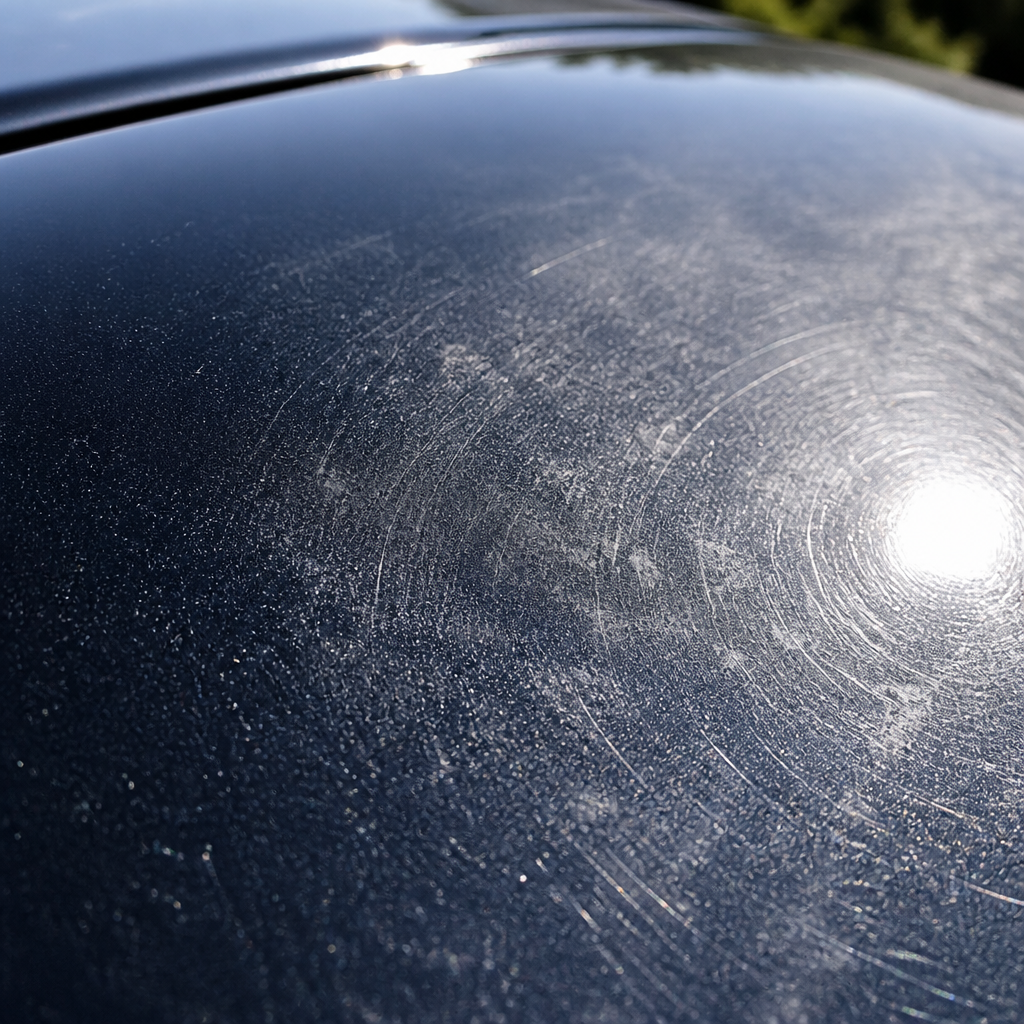
Modern automotive paint is a layered system: primer, color base coat, and a clear coat on top that handles the majority of UV exposure so the color beneath it does not fade directly. That clear coat is a polymer. UV radiation, specifically UVA and UVB rays, breaks down the polymer chains through a process called photodegradation, producing a surface that progressively loses gloss, turns hazy or milky, and eventually flakes away from the base coat beneath it.
Illinois summers make this worse than a simple UV exposure story. The Chicago suburbs sit in a region where summer humidity stays high for extended stretches, temperatures regularly push vehicles' horizontal surfaces well beyond ambient air temperature, and urban particulate matter from the metro area mixes with precipitation to produce mildly acidic rain. Each of these variables compounds the clear coat stress independently. Together, they create what a proper post-season inspection almost always reveals: a paint surface that looks acceptable from ten feet away and reveals real damage the moment you run a clean hand across the hood or look at the paint surface under a focused light source.
Heat accelerates oxidation, the same basic process as rust, leaving a powdery film on the surface. Clear coat also becomes brittle with prolonged UV exposure, eventually cracking and beginning to separate. The damage is not announced with a loud event the way a rock chip is. It accumulates silently, and the correction required grows proportionally larger the longer it goes unaddressed.
The Five Damage Types to Assess After Summer
A post-summer paint assessment is not a single pass with a flashlight. There are five distinct damage categories that Illinois summers produce, and each requires a different remediation approach. Confusing them leads to applying the wrong process and either leaving damage behind or removing more clear coat than necessary.
UV Oxidation and Surface Haze
This is the foundational damage from prolonged UV exposure. The clear coat's crosslink density degrades at the surface, producing an oxidation zone that creates the chalky or hazy appearance associated with older paint. On modern vehicles, this initially looks like reduced depth and gloss rather than obvious chalking. Rub a clean white microfiber across the panel in a dark area. If it comes back with a white or tinted residue, oxidation is present and the surface layer is actively degrading.
Water Spot Etching
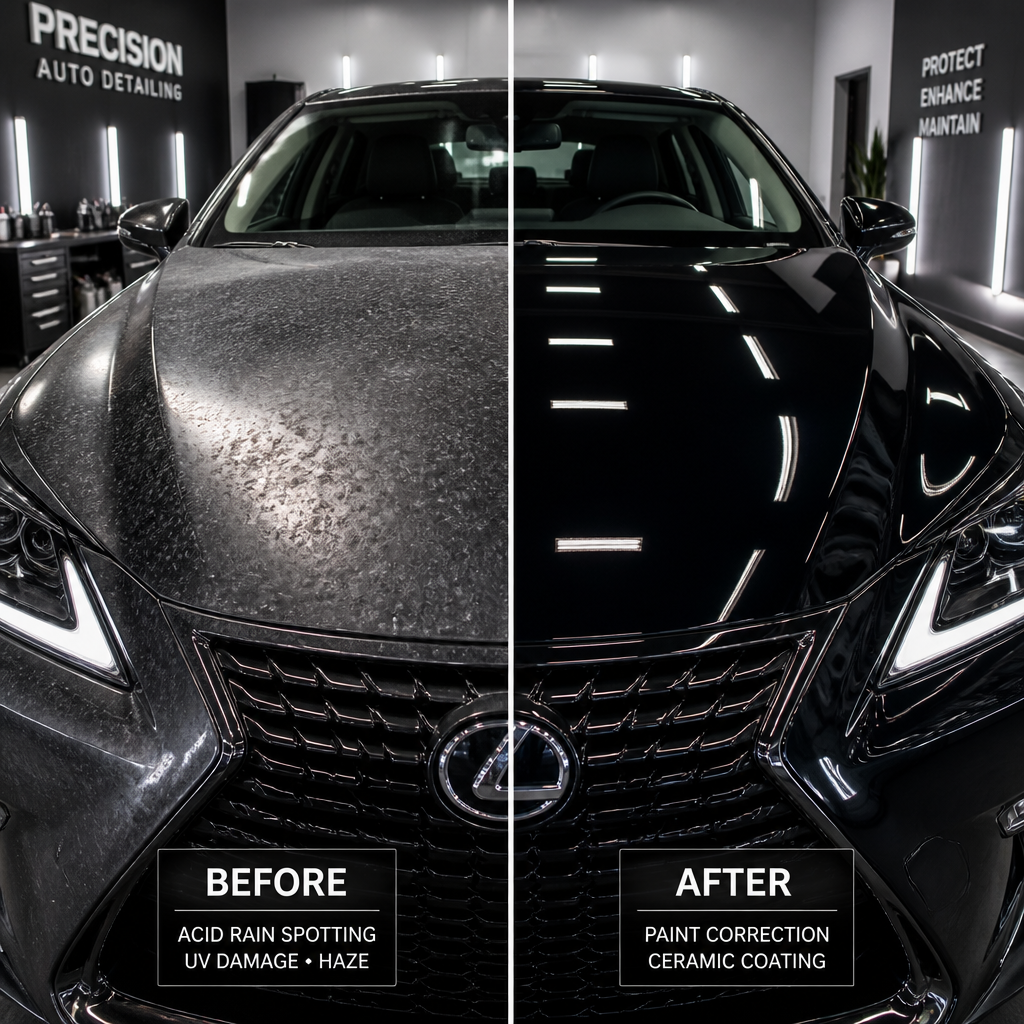
Illinois summer thunderstorms, sprinkler overspray, and hard water from hose washing all leave mineral deposits. When these dry on hot paint, the water evaporates rapidly and the minerals concentrate, etching into the clear coat rather than sitting on top of it. Horizontal panels are the highest-risk areas because water pools and dries there. No spray detailer removes an etch mark. The surrounding clear coat must be polished to level the surface. Inspect every panel in direct sunlight at a low angle specifically for water spot etching after summer.
Bug Protein Etching and Tree Sap Hardening
Insect remains contain proteins and organic acids that begin etching clear coat within hours on a hot surface in summer. Bug guts left on a hot hood for a weekend in July can become permanent low-grade damage that no clay bar will address. Tree sap operates similarly. A soft sap blob in June is a rock-hard bonded resin by August, and summer heat continues hardening it the longer it sits. Both require assessment before any polishing begins to determine whether surface decontamination alone suffices or whether polishing compound is needed.
Iron Fallout Contamination
Every braking event throws microscopic iron particles that travel through the air and embed in nearby paint surfaces. Over a full summer of driving through Carol Stream, Bloomingdale, Wheaton, and onto suburban expressways, these particles accumulate across the entire vehicle surface. They rust in place and appear as faint orange freckles under close inspection with a quality LED light source. Iron fallout does not wash off. It requires a dedicated iron decontamination chemical, which dissolves the embedded particles through a chemical reaction before any further work proceeds.
Swirl Marks and Fine Scratches from Summer Washing
Automated car washes, improper hand-washing technique, and the grit that builds up on microfiber towels during summer washing all introduce swirl marks into the clear coat. These circular or linear fine scratches become dramatically more visible in direct sunlight as oxidation reduces the paint's depth and gloss. A vehicle that looks clean in the garage will show a web of swirl marks on a bright fall morning in the driveway. These are correctable with machine polishing, but they need to be properly mapped before work begins.
Pro tip: Run a clean plastic sandwich bag slowly across a freshly washed, dried panel after summer. The thin plastic amplifies surface roughness that your bare hand cannot detect, and it will immediately tell you whether you are dealing with bonded contamination, surface etching, or a relatively smooth paint surface that needs only light correction.
How to Inspect Your Paint Correctly
The single most common mistake in paint assessment is doing it in the wrong conditions. Shade, artificial garage lighting, and a dirty surface all hide damage that is immediately obvious under the right conditions. The inspection process matters as much as what you are looking for.
Start with a proper two-bucket wash and full rinse to remove loose contamination. Dry the vehicle completely. Then move it into direct sunlight, or use a high-powered focused LED inspection light in a dark environment. Work panel by panel, holding the light at a low, raking angle across the surface. This reveals swirl marks, etched water spots, and surface haze that are completely invisible under overhead lighting. Pay particular attention to the hood, roof, and trunk, because these horizontal panels receive direct perpendicular UV exposure and hold water the longest during summer storms.
After the visual inspection, run a clean hand across the paint. A smooth, contaminant-free surface feels like glass. Roughness or a gritty texture indicates bonded contamination that must be addressed through decontamination before any polishing. If a paint thickness gauge is available, this is the point to take baseline readings across all panels. That data determines how aggressively correction can proceed without compromising the clear coat's remaining depth.
Paint damage from heat and UV is cumulative and slow-moving. It does not announce itself the way a rock chip or door ding does. Instead, the finish loses depth, clarity, and gloss over a period of months, and by the time oxidation or clear coat degradation is obvious, the correction required is significantly more involved than it would have been with earlier intervention.
Pro tip: Never assess or treat water spots on hot paint. Move the vehicle to shade, allow all panels to cool to ambient temperature, and only then perform your inspection. Applying any product to hot clear coat accelerates bonding and can introduce new defects during what should be an assessment step only.
Comparing Correction Approaches: Which Situation Calls for What
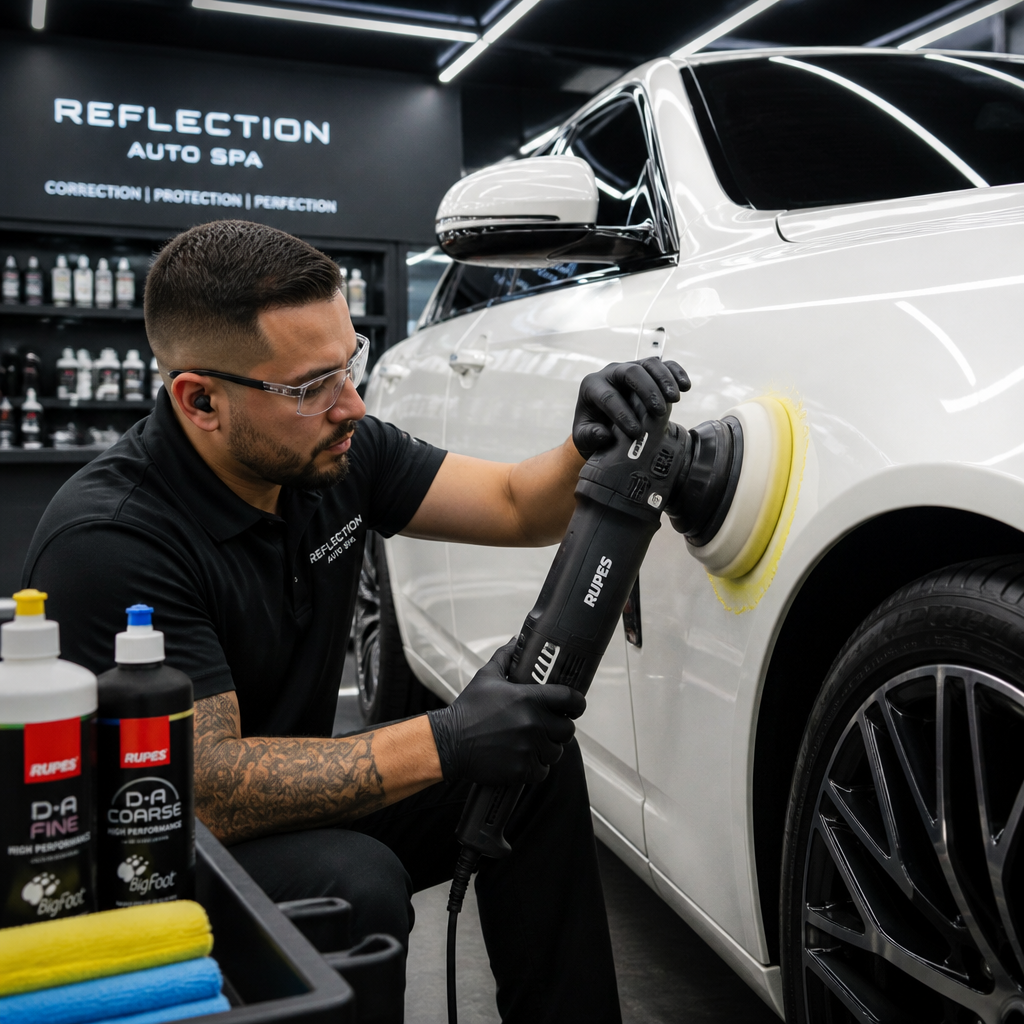
Not every vehicle that comes through a post-summer assessment needs the same level of intervention. Using too aggressive a process removes clear coat unnecessarily. Using too light a process leaves damage behind and frustrates the vehicle owner when it reappears immediately. The comparison below maps the most common post-summer scenarios to the correct approach.
| Damage Level Found at Assessment | Correct Approach | What It Addresses |
|---|---|---|
| Light surface contamination, no etching, minimal swirls | Full decontamination wash + iron fallout removal + clay bar + finishing polish | Removes bonded contamination and minor surface oxidation. Restores gloss without significant clear coat removal. Ideal for vehicles with existing protective coatings or newer paint in good condition. |
| Moderate swirls, water spot etching, early UV haze | Full decontamination + single-stage machine polishing with medium cut compound + LSP application | Removes moderate defects through controlled clear coat leveling. Addresses etched water spots and early oxidation zones. Appropriate for most vehicles after an unprotected Illinois summer. |
| Heavy oxidation, deep swirls, multiple etched water spots, possible bird dropping damage | Full decontamination + multi-stage machine polishing (heavy cut followed by finishing stages) + ceramic coating or paint protection film | Maximally restores clear coat before sealing the surface. Multi-stage work uses a cutting compound to remove heavy defects, followed by progressively finer polishing stages to restore depth and clarity. Paint thickness measurement is essential before and during this process. |
A common mistake is selecting the correction approach before completing the assessment. The right compound and pad combination only becomes clear after the paint surface is clean, cool, properly illuminated, and thickness-measured. Skipping that sequence results in either under-correction that leaves visible damage, or over-correction that removes more clear coat than the panel had to give.
Why Fall Is the Right Window for Paint Correction in the Chicago Suburbs
There is a persistent assumption that spring is the natural time for automotive detailing work. For Chicago-area vehicles, fall is actually the more strategically sound choice, for reasons that are practical rather than seasonal marketing.
First, the damage is fresh and known. A post-summer assessment captures everything Illinois heat and UV inflicted during the peak stress period. Waiting until spring means adding five months of winter road salt exposure, brine, sand, and freeze-thaw cycle contamination on top of already-degraded clear coat, which dramatically increases the complexity and cost of correction.
Second, ambient temperature conditions in September and October across Glendale Heights, Carol Stream, Bloomingdale, and Wheaton are ideal for machine polishing and ceramic coating application. Ceramic coatings require specific temperature ranges and humidity levels to cure properly. Illinois summer heat and humidity create conditions that demand controlled environment work. Fall ambient conditions allow more consistent results even outside of a climate-controlled shop environment.
Third, fall correction followed by a quality ceramic coating or paint sealant puts a protective barrier between the freshly corrected clear coat and the single most corrosive season Illinois delivers: winter. Road salt, brine, and the freeze-thaw cycle that runs from November through March are genuinely destructive to unprotected paint surfaces. Heading into winter with compromised, summer-damaged clear coat and no protective layer is how vehicles arrive in spring needing complete respray rather than correction.
Pro tip: If your vehicle has a protective ceramic coating from a previous season, the post-summer assessment still matters. Ceramic coatings require maintenance washes to perform correctly, and the coating itself can accumulate surface contamination, mineral deposits, and iron fallout over a summer. A professional ceramic maintenance inspection determines whether the coating is still performing as intended or whether a targeted decontamination and reapplication of a top coat layer is needed before winter.
Ceramic Coating as the Exit Strategy
Paint correction without subsequent protection is a temporary solution. Clear coat that has been corrected is smooth, freshly leveled, and highly susceptible to recontamination the moment the vehicle returns to the road. The correct sequence is: full decontamination, paint correction to the appropriate level, and then the application of a durable protection layer that reduces the rate at which next summer's UV, bugs, water spots, and iron fallout can reach the clear coat.
Professional nano-ceramic SiO2 coatings are the most durable option currently available for exterior paint protection. Applied correctly to a properly prepared surface, they create a hard, chemically bonded layer that resists UV degradation, repels water and mineral deposits, makes bug and sap removal dramatically easier before etching occurs, and reduces swirl mark introduction during routine washing. The critical operative phrase is "applied correctly to a properly prepared surface." Ceramic coatings bond to whatever is on the paint surface at the time of application. Contamination, oxidation, or moisture trapped beneath the coating becomes a permanent feature of the finish.
At Hersheys Detailing, the ceramic coating process always begins with full decontamination and appropriate paint correction. The coating is not applied as a shortcut over summer damage. It is applied as a final protection layer over paint that has been brought to the best condition the clear coat can support. The 5-8 year warranty on our nano-ceramic SiO2 coatings reflects that preparation standard, not just the coating product itself.
For vehicles that already experienced a summer without protection, the exterior detailing assessment before any coating application determines what level of correction is needed. Vehicles with light summer damage may proceed to coating after a single-stage polish. Vehicles that show significant oxidation, deep water spot etching, or heavy swirl marks require multi-stage machine polishing before the surface is ready to accept a coating. That determination comes from the assessment, not from assumptions about the vehicle's age or color.
The maintenance program that follows ceramic coating application is equally important. A correctly maintained ceramic-coated vehicle heading into an Illinois winter arrives at next summer's post-season assessment in dramatically better condition than an unprotected vehicle. That difference compounds across seasons. A vehicle that receives proper fall correction and coating, followed by maintenance washes through winter and summer, retains clear coat thickness and paint depth that an unprotected vehicle loses permanently over the same period.
Frequently Asked Questions
How do I know if my car's clear coat has been permanently damaged by Illinois summer heat?
The clearest sign of irreversible clear coat damage is flaking or peeling, where the clear coat physically separates from the base coat beneath it. Short of that, inspect the paint under direct sunlight at a low angle. Persistent white or chalky haze that does not improve when the panel is wet, or a texture that feels rough despite being clean, indicates significant UV oxidation. Etched water spots that feel like depressions or craters in the surface rather than surface contamination also indicate clear coat damage that requires polishing to address. A professional paint thickness measurement across panels will confirm whether sufficient clear coat remains for correction or whether the situation requires more extensive remediation.
Is fall detailing really better than waiting until spring in the Chicago suburbs?
Yes, for two specific reasons. First, post-summer damage is fresher and more isolated in fall than it will be after an Illinois winter adds salt, brine, and freeze-thaw contamination on top of it. Second, fall correction followed by ceramic coating or a quality sealant puts a protective barrier between corrected paint and the most corrosive season the Chicago area delivers. Waiting until spring means driving through winter with already-compromised clear coat and no protection layer, which typically results in significantly worse conditions requiring significantly more work by March.
Can I assess summer paint damage myself, or do I need professional equipment?
You can do a meaningful initial inspection yourself with direct sunlight and a clean hand. Wash and fully dry the vehicle, move it into direct sun, and examine each panel at a low raking angle. Surface roughness, swirl marks, and early water spot etching are visible without tools in these conditions. However, a professional assessment adds paint thickness gauge measurements across all panels, which is the only way to determine how aggressively correction can safely proceed without breaching the clear coat. It also includes a trained eye for damage types that look similar at first glance but require completely different approaches, such as the difference between surface contamination and etched clear coat.
My car is dark colored. How much worse is the summer damage compared to a white or silver vehicle?
Meaningfully worse in two ways. Dark-colored vehicles, particularly black, deep navy, and dark red finishes, absorb more solar heat than lighter finishes, which accelerates the rate of oxidation and speeds up UV degradation of the clear coat's polymer chains. Second, swirl marks, surface haze, and water spot etching are dramatically more visible on dark finishes in direct sunlight. A white vehicle with moderate summer swirl damage may appear acceptable from a few feet away. The same level of damage on a black vehicle is conspicuous in any outdoor lighting. This means dark vehicle owners typically need more thorough post-summer correction to achieve visually clean results, not necessarily more damage has occurred, but the damage threshold at which it becomes visible is much lower.
What does summer humidity in Illinois specifically do to paint that dry-climate UV exposure does not?
High humidity amplifies several damage mechanisms simultaneously. Mineral-rich water spots from summer thunderstorms etch more aggressively into clear coat when the humidity keeps the surface damp longer before evaporation concentrates the minerals. Illinois urban precipitation also carries pollutants from the Chicago metro area that make it mildly acidic, which accelerates the etching process compared to mineral deposits alone. Humidity also keeps biological contaminants, bird droppings, bug protein, and tree sap, more chemically active on the paint surface, increasing the rate of acid etching during warm, humid overnight periods when the vehicle is parked. Finally, humidity complicates ceramic coating application in summer, which is one reason fall is a better season for that work in the Chicago suburban area.
How long does post-summer paint correction typically take for a vehicle in the Chicago suburbs?
Light single-stage correction on a vehicle with existing protection and minor summer damage can be completed in a focused half-day session. A vehicle with moderate oxidation, multiple etched water spots, and significant swirl marks from a summer without protection typically requires a full day of machine polishing work after decontamination. Vehicles with heavy oxidation, deep etching, or widespread surface damage from multiple unprotected seasons require multi-stage correction that may span two days. The assessment determines the scope, and the scope determines the time. Any estimate given before a proper post-wash inspection is a guess, not a professional recommendation.
Have you noticed specific panel areas on your vehicle that seem to show the most summer damage year after year? Share what you have observed. It helps other Chicago-area owners know where to focus their fall inspection.
References
- End-of-summer paint recovery: UV oxidation, bug etching, and clear coat restoration workflow
- Why Chicago-area vehicles need year-round paint protection against UV, salt, and seasonal hazards
- How summer heat and UV drive cumulative clear coat degradation through photodegradation
- Professional water spot assessment and etched clear coat treatment techniques
- Paint correction assessment: identifying oxidation, etching, swirl marks, and chemical staining