Most car owners judge a detail by what the car looks like when they pick it up. What they never see is whether the shop could actually find the defects in the first place. That distinction is everything in a professional detailing process Illinois owners rarely think about until they have experienced a shop that cut corners under bad lighting and handed back a car that still had swirl marks and holograms buried in the clear coat. At Hersheys Detailing in Glendale Heights, studio lighting is not a luxury upgrade. It is the foundation of every multi-stage correction and ceramic coating application performed on vehicles from Carol Stream, Bloomingdale, Wheaton, and across the Chicago suburbs.
Table of Contents
- Quick Takeaways
- Why Lighting Determines Results, Not Just Visibility
- What Bad Lighting Actually Hides from Your Detailer
- The Science Behind Studio Lighting Specs: CRI, Kelvin, and Placement
- How Hersheys Uses Lighting at Each Stage of the Detail
- Controlled Studio Lighting vs. General Garage Lighting: A Side-by-Side Look
- What to Ask a Detailer Before You Book
- Frequently Asked Questions
- References
Quick Takeaways
| Key Insight | Explanation |
|---|---|
| CRI 90+ is the professional minimum | A Color Rendering Index below 90 causes studio lights to misrepresent paint color and texture, hiding swirl marks and haze that would be obvious in natural daylight. |
| 5000K to 6500K color temperature is the target range | Daylight-spectrum LEDs in this range expose paint defects that warm-white bulbs actively conceal, making them the correct choice for any serious paint inspection or correction bay. |
| Overhead lighting alone is never enough | Side panels, cross-lighting bars, and handheld inspection lights each reveal defect categories that overhead floods completely miss, especially horizontal scratches and micro-marring. |
| Lighting affects ceramic coating quality, not just correction quality | High spots and uneven coating coverage are invisible under poor lighting. Applying nano-ceramic SiO₂ coatings without studio conditions risks application errors that are locked in once the coating cures. |
| A handheld inspection light is non-negotiable for panel-by-panel work | Tight areas like bumpers, door jambs, and lower rocker panels require a focused portable beam that no overhead or wall-mounted fixture can replicate at the correct angle. |
| Glare is just as damaging as insufficient light | Overly bright or undiffused LEDs flatten paint texture and create dead zones where defects hide behind reflected light, producing the same missed-defect result as a dim shop. |
| Standardized lighting reveals the truth before the customer does | Using the same inspection light before and after each correction stage means defects are caught internally, not at delivery or in a parking lot under sunlight. |
Why Lighting Determines Results, Not Just Visibility
There is a persistent misconception that lighting is about making the workspace comfortable. In a professional detailing studio, lighting is a diagnostic instrument. It is the difference between a paint correction that genuinely removes 90 percent of defects and one that appears to because the shop could not see the remaining 10 percent.
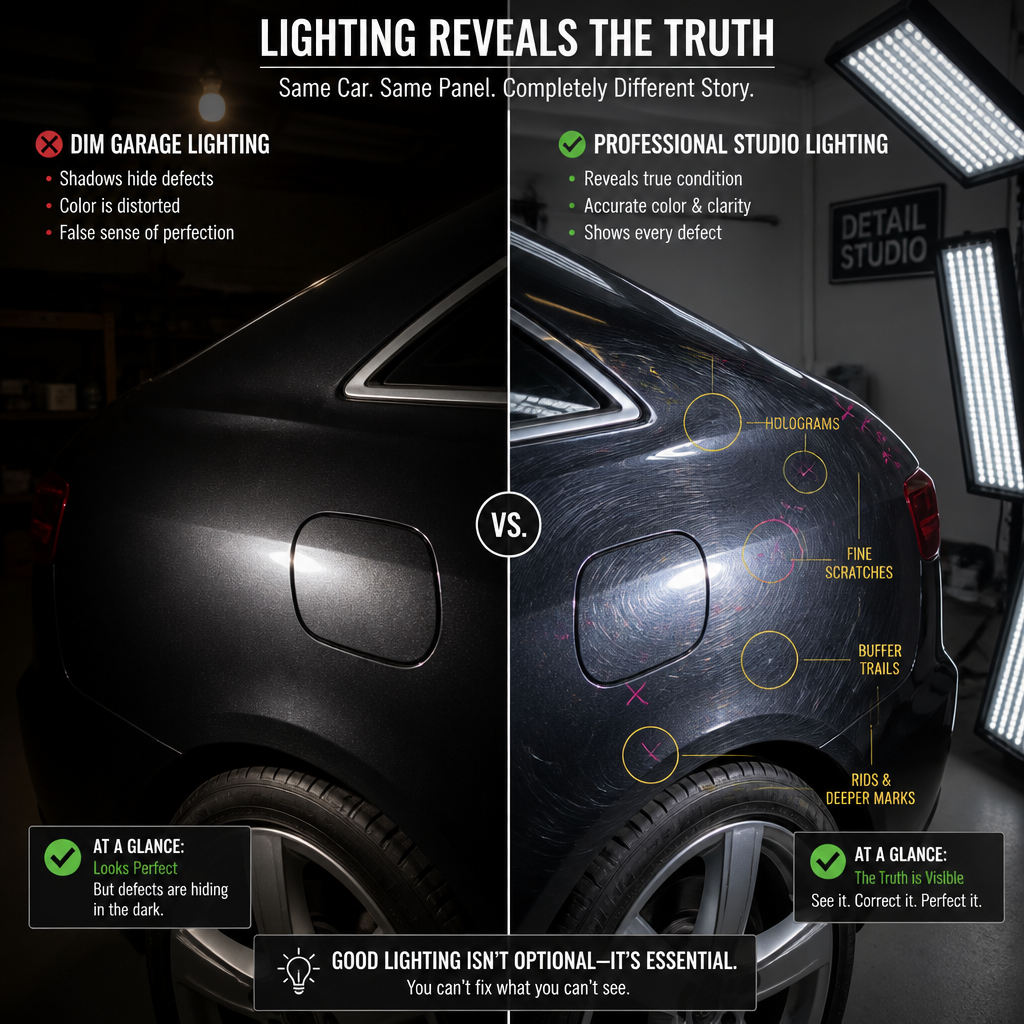
Paint reacts differently under different light sources. A swirl mark that is vivid under a 6000K daylight spotlight can become practically invisible under a warm-white fluorescent. A hologram left by an improperly used rotary polisher can vanish under overhead floods and only reappear when the car pulls into a sunny parking lot. At that point, the correction is finished and the coating may already be curing. There is no fixing it without starting over.
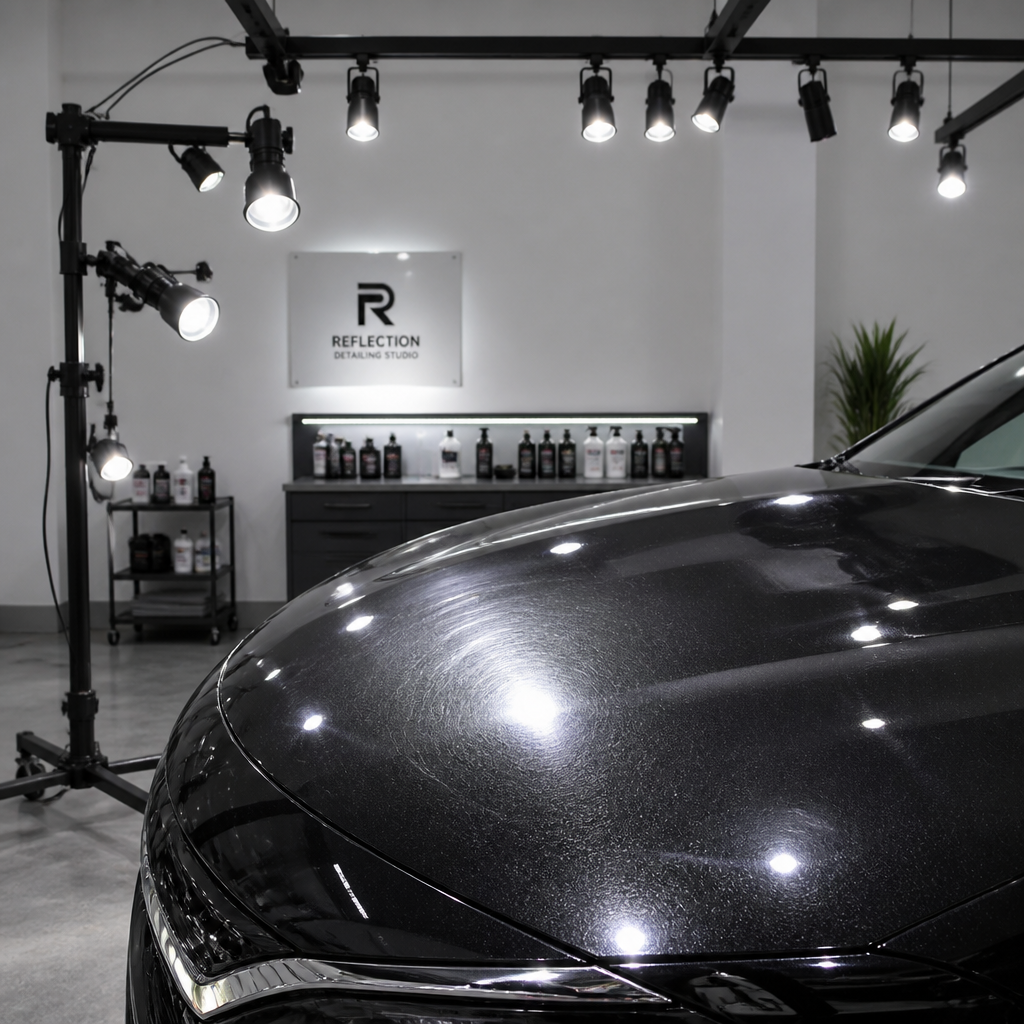
This is why a controlled studio environment is not a marketing term at Hersheys Detailing. It is a practical requirement for the multi-stage machine polishing and decontamination process that precedes every ceramic coating application they perform in Glendale Heights.
General garage fixtures can make a space look evenly lit while still hiding the marks detailers care about. For paint correction and ceramic coating, that is where bad lighting becomes expensive: you can under-correct, over-polish, or miss high spots until the car leaves the bay.
Pro tip: Before booking any detailer for paint correction or ceramic coating, ask specifically what type of lighting the correction bay uses. A shop that cannot answer that question with specifics has probably never thought about it, and that tells you everything about their process.
What Bad Lighting Actually Hides from Your Detailer
The defects that bad lighting conceals are exactly the ones that matter most to owners of luxury and high-end vehicles. These are not surface-level dirt issues that any wash removes. They are structural paint defects that require skilled correction and can only be confirmed through proper inspection lighting.
Swirl Marks and Buffer Trails
Swirl marks are circular micro-scratches typically caused by improper washing, automatic car washes, or dry wiping. Under warm-white or single-source overhead lighting, these marks blend into the paint's base sheen and become nearly invisible. Under a 5000K to 6500K daylight LED at the correct angle, they appear as a dense web pattern, often far more severe than the owner realized.
Buffer trails, sometimes called holograms, are marks left by machine polishers when the wrong pad, product, or speed combination is used. These are particularly insidious because they are introduced during the correction process itself. Without the right lighting, a detailer can create holograms while trying to remove swirl marks and never know it until the car is seen in direct sunlight.
Clear Coat Depletion and Panel Unevenness
On vehicles with prior paint work, amateur correction attempts, or significant weathering, the clear coat may be thinning unevenly across panels. Gloss differences between panels, or between the center and edges of a single panel, are extremely difficult to detect without proper cross-lighting. Missing these variations leads to over-polishing, which removes what little clear coat remains and causes permanent damage.
For Chicago suburb vehicles that endure road salt, freezing temperatures, and seasonal UV exposure across Illinois winters and summers, clear coat condition is a genuine concern. A detailer who cannot see clear coat variation accurately is operating blind on exactly the vehicles that need the most careful assessment.
The Science Behind Studio Lighting Specs: CRI, Kelvin, and Placement
Understanding why studio lighting works requires a basic grasp of three specifications: Color Rendering Index, color temperature, and fixture placement. These are not arbitrary preferences. Each one directly affects which paint defects can be detected and corrected.
Color Rendering Index: Why 90+ CRI Is the Floor
CRI measures how accurately a light source renders the colors of objects compared to natural daylight. A CRI of 100 is perfect natural daylight. Most standard shop and garage fixtures operate in the 70 to 80 CRI range, which is adequate for general work visibility but actively misrepresents paint surfaces. Professional detailing studios target a minimum of 90+ CRI, with 95+ preferred in studio setups where subtle defects must stay visible throughout every correction stage.
In practical terms, higher CRI makes it easier to judge swirls, haze, and coating residue because the light is faithfully showing the surface rather than distorting it. Lower CRI does not just reduce visibility. It introduces false information. A detailer working under 75 CRI lighting is essentially working with inaccurate data about the surface they are correcting.
Color Temperature: The 5000K to 6500K Window
Color temperature, measured in Kelvin, determines whether light reads as warm or cool. The daylight band from 5000K to 6500K replicates the spectrum of natural sunlight. This range is the target for professional detailing bays because it is the same light under which most paint defects become visible to the human eye outdoors.
Warm-white bulbs in the 2700K to 3500K range create a comfortable environment but function like a visual suppressor for paint defects. Many paint shops use warmer lighting for exactly this reason: vehicles look better than they are. A professional detail shop needs the opposite. It needs lighting that makes everything visible, including defects the vehicle owner has not noticed yet.
Placement: Why One Light Source Is Never Enough
Even the highest CRI, perfectly tuned 6000K fixture fails if it is the only light source in the bay. Single-source or overhead-only setups create predictable blind spots. Horizontal scratches and uneven polishing patterns are revealed by cross-lighting from vertical side panels or bars mounted along the bay walls. Tight recesses around bumpers, lower panels, and door jambs require handheld inspection lights at specific angles that no mounted fixture can replicate.
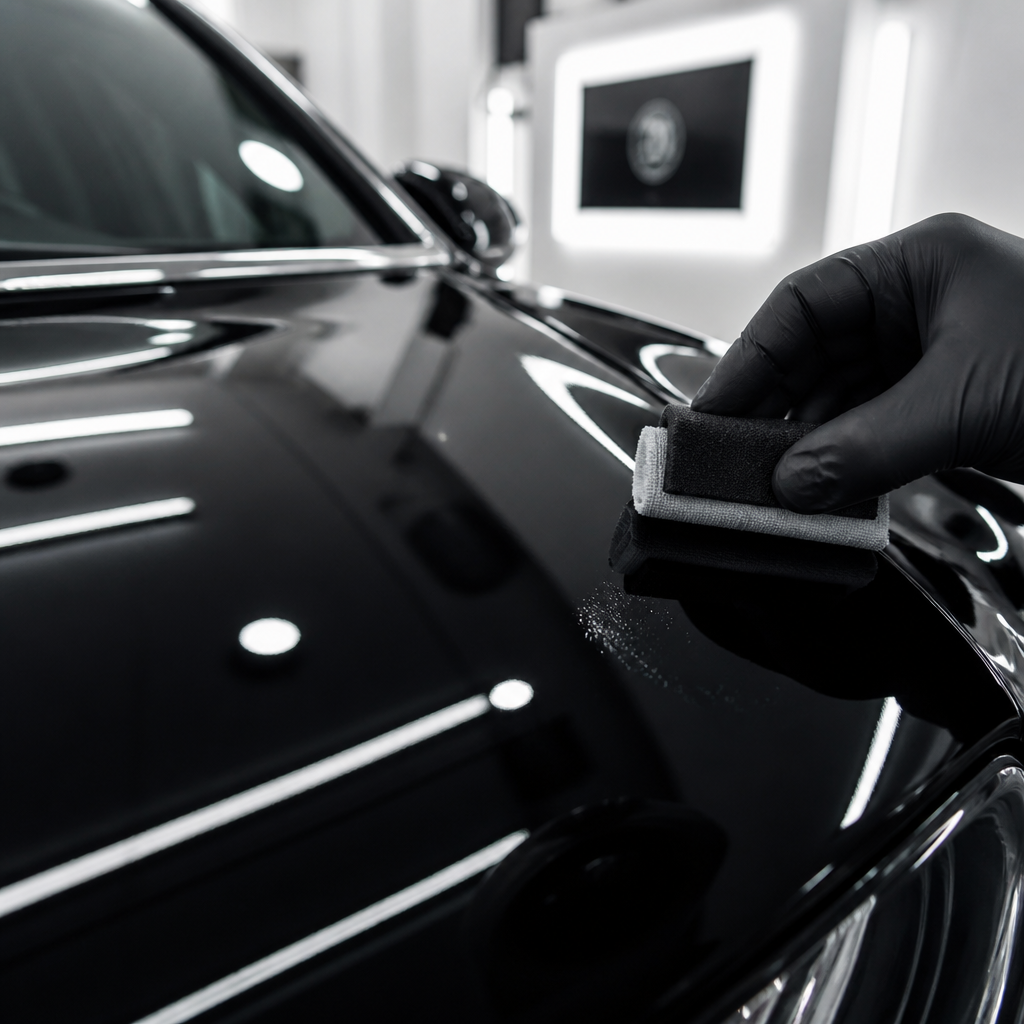
Pro tip: Micro-marring, which is the finest category of surface scratch and the hardest to detect, is most reliably found by holding a portable inspection light off-angle close to the panel surface. This technique is standard in a professional studio process and completely impractical without a high-quality handheld light as part of the setup.
How Hersheys Uses Lighting at Each Stage of the Detail
The Hersheys Detailing process in Glendale Heights is structured around stage-by-stage inspection under controlled conditions. Lighting is not used once at the beginning and once at the end. It is applied at every transition point in the workflow because defects can be introduced at any stage, not just inherited from the vehicle's history.
Pre-Work Paint Assessment
Before any chemical or mechanical correction begins, each vehicle undergoes a thorough paint assessment under studio lighting. This establishes a baseline: the true condition of the clear coat, the depth and distribution of existing defects, any prior paint work or filler use, and areas of thinning or vulnerability. This assessment directly determines which correction approach is appropriate. Skipping it or performing it under poor lighting means the entire subsequent process is built on guesswork.
Decontamination Inspection
After the decontamination stage, which removes bonded contamination including iron fallout, industrial deposits, and tar, the surface is re-inspected. Decontamination changes how light interacts with the paint and can reveal defects that were visually masked by surface contamination. This intermediate check ensures the correction stage starts with accurate knowledge of what is actually on the paint surface, not what appeared to be there before decontamination.
Between Polishing Stages
Hersheys' multi-stage machine polishing process involves moving through progressively finer compounds and pads. After each polishing stage, the panel is inspected under studio lighting before moving forward. This intermediate check catches introduced holograms, uneven correction, or areas where additional passes are needed before the finer product is applied.
This is where the difference between a professional detailing process Illinois drivers deserve and a single-stage polish from a budget competitor becomes concrete. A shop that performs a single machine polish pass and delivers the car has no way of knowing whether holograms were introduced in the process unless the inspection lighting is in place to show them.
Pre-Coating Final Inspection
Before any nano-ceramic SiO₂ coating is applied, the corrected surface is inspected one final time under full studio conditions. This is the most critical check in the entire process. Any residue, missed defect, or surface irregularity that passes this point gets locked under the coating. Ceramic coatings with 5-year and 8-year warranties depend on this inspection being accurate, because the coating is permanently bonding to whatever surface exists beneath it at application.
Controlled Studio Lighting vs. General Garage Lighting: A Side-by-Side Look
The practical gap between a professional studio setup and a general garage or mobile detail operation is not marginal. It affects every specific outcome a high-end vehicle owner cares about.
| Capability | Professional Studio Lighting (90+ CRI, 5000-6500K, Multi-Point) | General Garage or Mobile Lighting |
|---|---|---|
| Swirl mark detection | Full visibility across all panels including dark and light paint colors | Partial or absent, especially on dark vehicles and in warm-white light |
| Hologram and buffer trail detection | Visible during correction, allowing real-time correction and verification | Often invisible until the vehicle is viewed in direct sunlight post-delivery |
| Clear coat condition assessment | Cross-lighting reveals panel-to-panel gloss variation and thinning zones | Uniform-looking lighting misses variation, risking over-polishing on compromised panels |
| Ceramic coating application quality | High spots and residue visible before and during application | Application errors invisible until coating cures, requiring costly rework |
| Tight panel inspection | Handheld inspection lights access bumpers, jambs, and lower panels at correct angles | Recessed areas and lower panels routinely missed or inadequately checked |
What to Ask a Detailer Before You Book
For owners of BMWs, Mercedes, Porsches, and other high-value vehicles in the Carol Stream, Bloomingdale, and Wheaton areas, the booking conversation with any detailer is an opportunity to evaluate process quality before a dollar is spent. Most shops reveal their standards in how they answer a few direct questions.
Ask what CRI rating their correction bay lights operate at. Ask whether they use cross-lighting and handheld inspection lights in addition to overhead fixtures. Ask whether they inspect the surface between polishing stages or only at the beginning and end. Ask what lighting conditions are used during ceramic coating application. A detailer who can answer all four questions specifically is running a professional process. A detailer who answers with vague reassurances about experience or equipment brand names has not thought about any of it.
Also ask whether the correction is performed indoors under controlled conditions at all times. Mobile detailing operations and shops with open bay doors introduce variable natural light, which changes throughout the day and season. In Illinois, outdoor light in November is not the same as outdoor light in July, and neither is consistent enough for reliable paint inspection. A dedicated indoor studio eliminates that variable entirely.
The ceramic coating service at Hersheys Detailing in Glendale Heights includes a full 2-step paint correction performed inside their studio, ensuring lighting conditions are controlled at every inspection point from the initial assessment through final coating application. Their exterior detailing and paint correction services follow the same studio-based process, applied to every vehicle regardless of how minor the requested work appears to be.
Frequently Asked Questions
Does lighting really matter if my car just needs an interior detail?
For a purely interior-focused service, the stakes around studio lighting are lower but not zero. Soft, targeted illumination is still important for spotting stains, embedded dirt in carpet fibers, and dust in vent crevices that overhead ambient light misses. A well-lit studio benefits interior work too, though the consequences of inadequate lighting are most severe on exterior paint work.
Can a mobile detailer achieve the same results as a studio shop?
Not for paint correction and ceramic coating application. Mobile setups cannot control ambient light, which changes throughout the day and varies by season and weather conditions. In Illinois specifically, outdoor natural light ranges from overcast gray in winter to harsh midday sun in summer, neither of which is consistent or controllable. A studio environment eliminates that variable, which is why Hersheys Detailing performs all correction and coating work inside their Glendale Heights studio.
What paint defects are most likely to be missed under poor lighting?
Holograms (buffer trails introduced during polishing), micro-marring, and early-stage clear coat depletion are the three categories most frequently missed under inadequate lighting. Holograms in particular are especially problematic because they are introduced during the correction process itself and require the right lighting to detect in real time. Swirl marks on dark-colored paint, which are dense and fine, are another category that warm-white or single-source lighting consistently fails to reveal accurately.
How does studio lighting affect the quality of a ceramic coating specifically?
Ceramic coatings bond permanently to the surface beneath them. Any residue, uneven correction, or surface defect that is not identified before application becomes sealed under the coating. High spots, which are areas where coating product sits too thick and cures unevenly, are invisible under poor lighting until they appear as dull patches after curing. Studio lighting during application allows these to be wiped before they set. This is directly relevant to coatings carrying 5-year and 8-year warranties, where the application quality determines whether the warranty has any practical meaning.
Why do some shops that seem well-equipped still miss defects?
Equipment quality and equipment use are separate things. A shop can own high-specification LEDs and still position them incorrectly, skip intermediate inspections between polishing stages, or rely on overhead coverage without side or handheld lighting for panel-by-panel work. The professional detailing process that produces reliable results is a systematic workflow, not just a well-stocked tool list. Lighting fixtures that are in the room but not used at the right angles and stages contribute nothing to the outcome.
Is paint inspection under studio lighting something Hersheys does on every vehicle or only on expensive cars?
Every vehicle receives the same studio-based inspection process regardless of make or value. The reason is practical: skipping or shortcutting inspection on any vehicle creates the same risk of missed defects and application errors. A professional process is either consistent or it is not a professional process. Hersheys Detailing's approach in Glendale Heights applies the same multi-stage inspection to every vehicle that comes through the studio, which is what seven years and more than 500 vehicles detailed looks like in practice.
If you have had a detail done at a shop with questionable lighting conditions and want to share what you noticed when the car hit sunlight, or if you have questions about what to look for in a studio-based professional process, drop your experience in the comments below.
References
- How professional detailing bays use studio lighting to find and fix paint defects
- CRI, color temperature, and placement specs for professional car detailing garage lighting
- How automotive detail shops use LED inspection lights for panel-by-panel paint correction
- Common lighting mistakes in car detailing studios and how to avoid them